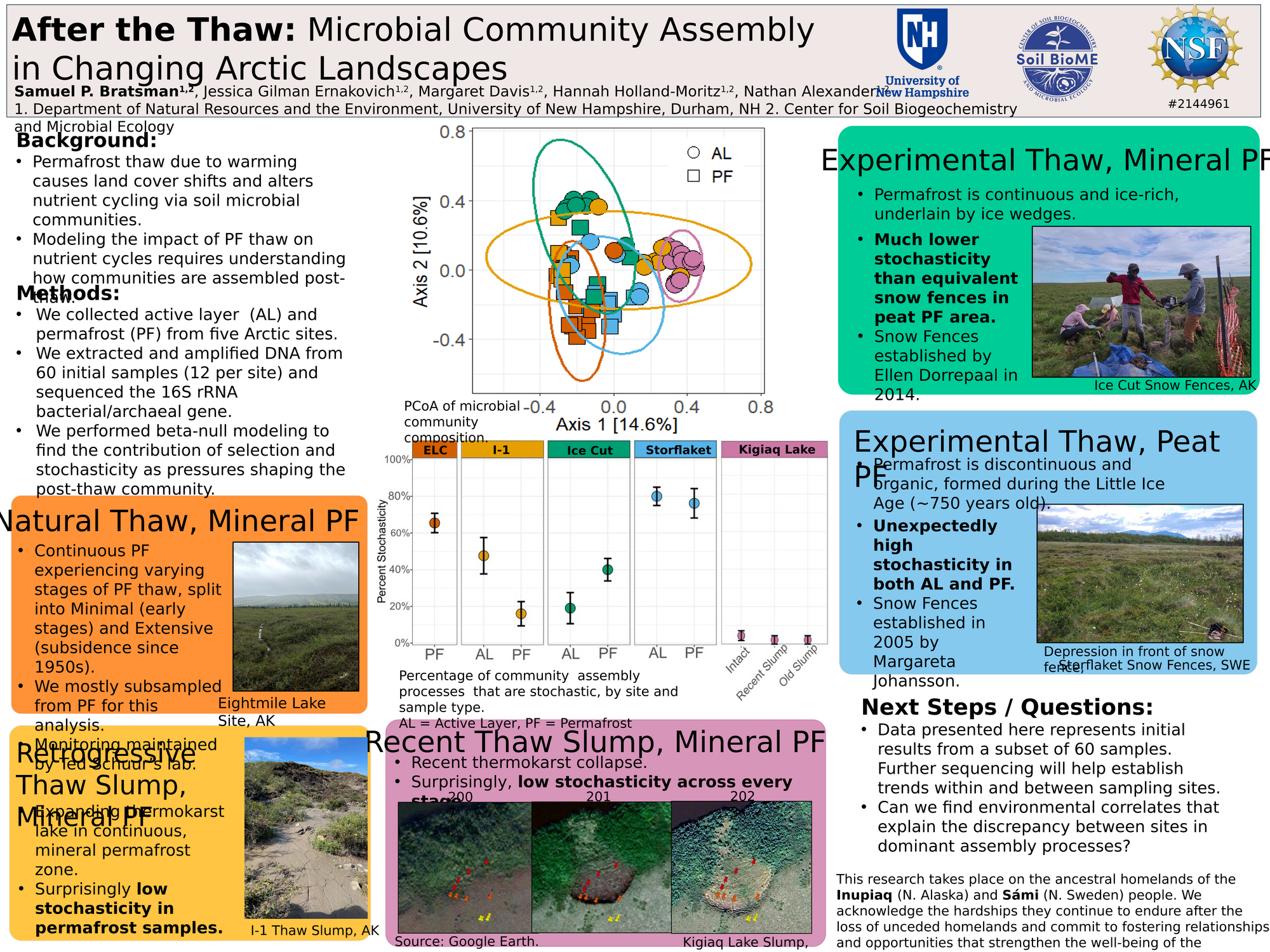
Title:
After the Thaw: Microbial Community Assembly in Changing Arctic Landscapes
Poster
Preview Converted Images may contain errors
Abstract
Permafrost thaw due to Arctic warming causes rapid changes to land cover and soil biogeochemical cycles in permafrost-affected landscapes. The deepening of seasonally-thawed active layers into permafrost introduces newly-exposed labile nutrients to microbial metabolism and plant uptake, resulting in increased decomposition, greenhouse gas emissions, and changes in plant communities and productivity. Soil microbes play key roles in soil biogeochemical cycling as they utilize various forms of carbon, nitrogen, and other soil nutrients as metabolites, so the composition of the post-thaw community will have a substantial impact on the fate of these newly-exposed nutrients. Yet, microbial communities are not shaped solely by the nutrients available to them, throughout thaw, they are subjected to various ecological pressures, including selective and stochastic processes (such as dispersal and drift) as well as interactions with the plant community, which may alter the post-thaw communities in unexpected ways. To understand the mechanisms shaping microbial communities during permafrost thaw and how universal these processes are across different types of permafrost-affected landscapes, we sampled active layer and permafrost soil from eight thaw chronosequences (using a “time since thaw” approach) from Sweden, Alaska, and Canada between 2022 and 2024 and sequenced the 16S rRNA gene from soil bacterial and archaeal communities. Sampling sites consisted of multiple permafrost ages and extent, organic matter content, and vegetation cover. Preliminary analyses revealed that microbial communities may follow a predictable trajectory through the process of permafrost loss, with implications for carbon and nutrient cycling during and after intermediate stages. We further used beta-null modeling to understand the relative contribution of selection and stochasticity as pressures shaping the post-thaw community composition and link these to microbial C and N-cycling potential. This study will inform a generalizable understanding of how permafrost thaw shapes microbial communities and consequently the fate of globally relevant pools of soil carbon and nutrients.
Authors
| First Name |
Last Name |
|
Nathan
|
Alexander
|
|
Hannah
|
Holland-Moritz
|
|
Margaret
|
Davis
|
|
Jessica
|
Gilman-Ernakovich
|
|
Samuel
|
Bratsman
|
Leave a comment
Submission Details
Conference GRC
Event Graduate Research Conference
Department Natural Resources and Earth Systems Science (GRC)
Group Teaching Excellence and Scholarship
Added April 15, 2026, 9:34 a.m.
Updated April 15, 2026, 9:35 a.m.
See More Department Presentations Here