Title:
Speech Category Learning Across the Lifespan
Poster
Preview Converted Images may contain errors
Abstract
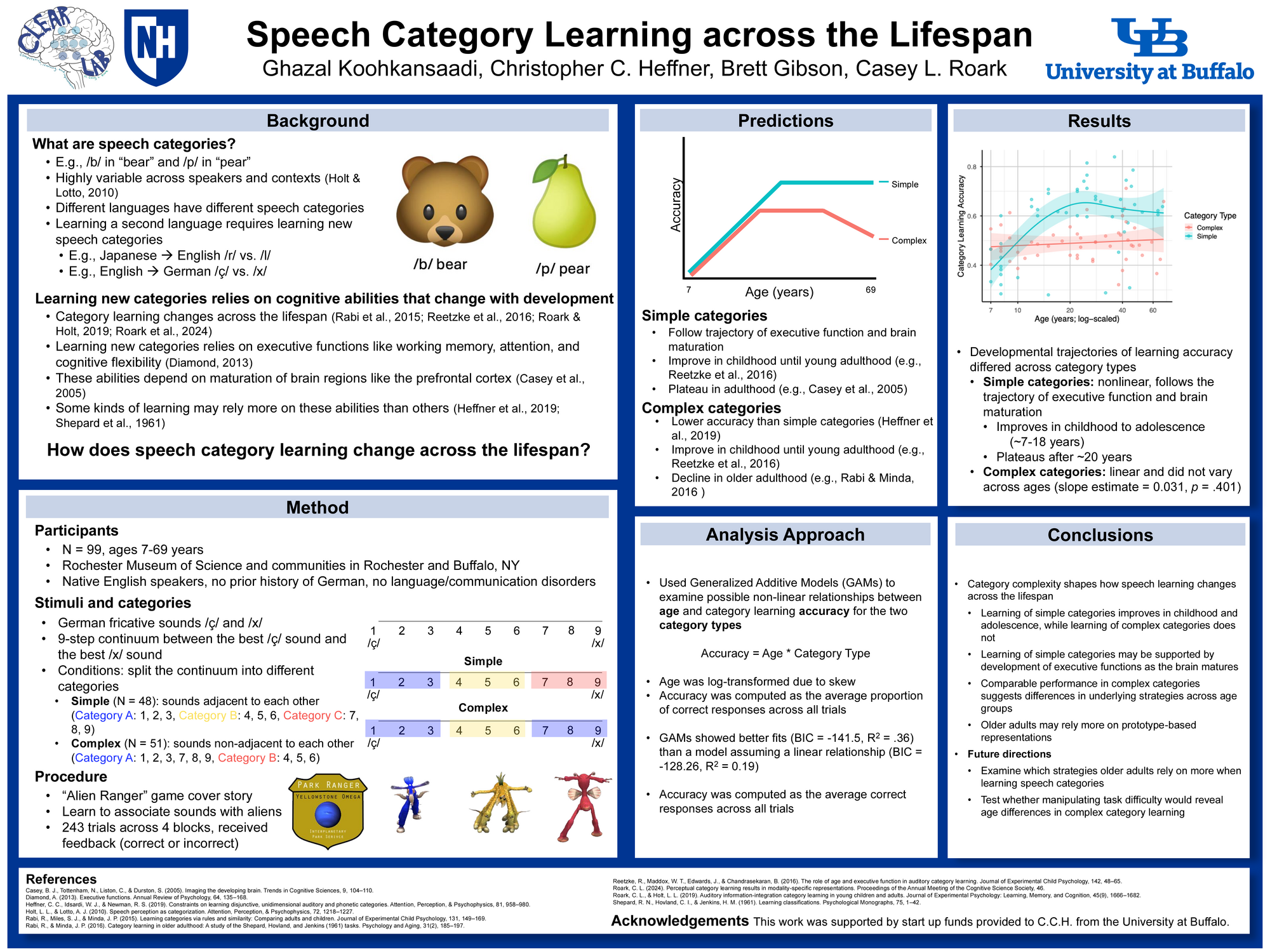
While adults generally struggle to learn new speech categories, it is not clear how learning changes across the lifespan. For nonspeech categories, learning changes across the lifespan are directly related to executive functions which undergo substantial changes across development, improving quickly across childhood to young adulthood and declining slowly in middle to older adulthood. In the current study, we examined speech learning across a wide age range (7-69 years, N = 99, monolingual English speakers) to understand how developmentally sensitive executive functions may contribute to successful speech learning. Stimuli formed a 9-step continuum of German fricatives (/x/ to /ç/) which was either divided into three continuous categories or two disjunctive categories. Disjunctive categories require more complex rules to learn, as perceptually distinct stimuli at the ends of the continuum belong to the same category. We compared the learning trajectories of continuous and disjunctive categories across the lifespan using generalized additive models. Learning of continuous categories improved steeply across childhood, plateauing in early adulthood. In contrast, learning of disjunctive categories was relatively constant across the lifespan. Overall, these findings suggest that age-related executive functioning abilities may contribute to successful learning of speech categories that can be easily described by rules.
Authors
| First Name |
Last Name |
|
Casey
|
L.Roark
|
|
Brett
|
Gibson
|
|
Christopher C
|
Heffner
|
|
Ghazal
|
Koohkansaadi
|
Leave a comment
Submission Details
Conference GRC
Event Graduate Research Conference
Department Psychology (GRC)
Group Teaching Excellence and Scholarship
Added April 14, 2026, 7:56 p.m.
Updated April 20, 2026, 10:10 a.m.
See More Department Presentations Here