Title:
Machine Learning the Calabi-Yau Metric in the Large Structure Limit
Poster
Preview Converted Images may contain errors
Poster
Preview Converted Images may contain errors
Preview still generating. May take a few minutes.
Abstract
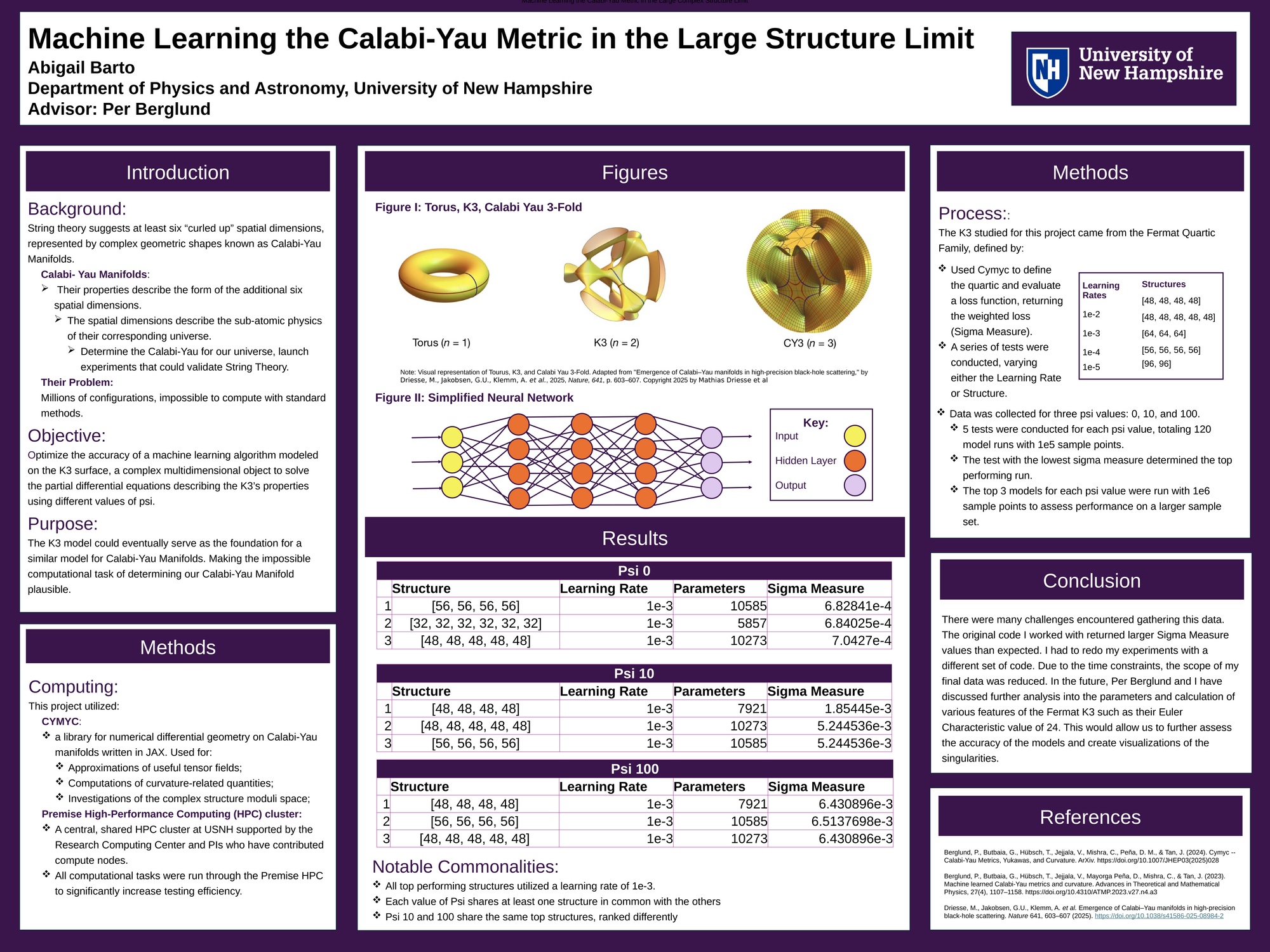
String theory suggests at least six “curled up” spatial dimensions, represented by complex geometric shapes known as Calabi-Yau Manifolds. Their properties describe these dimensions, which detail the subatomic physics of their respective universes. If the Calabi-Yau that matches our universe is discovered, it could pave the way for experiments that validate String Theory. This is currently impossible to do with standard computing methods. The objective of this research was to optimize the accuracy of a machine learning algorithm modeled on the K3 surface, a lower-dimensional manifold, to solve the partial differential equations describing the K3’s properties using different values of psi. The K3 model could eventually serve as the foundation for a similar model for Calabi-Yau Manifolds, turning the impossible computational task of determining our Calabi-Yau Manifold plausible. This project utilized the Cymyc library and Premise computing cluster to run a series of tests with various structures and learning rates. The success of each test was evaluated with the Sigma Measure, a weighted loss evaluated within the program. We identified the three top structures for Psi values of 0, 10, and 100. We intend to continue with this research, cross-referencing with other features of the Fermat K3 to further assess the accuracy.
Authors
| First Name |
Last Name |
|
Abigail
|
Barto
|
Leave a comment
Submission Details
Conference URC
Event Interdisciplinary Science and Engineering (ISE)
Department Physics (ISE)
Group Physics
Added April 20, 2026, 8:01 p.m.
Updated April 20, 2026, 8:02 p.m.
See More Department Presentations Here