Title:
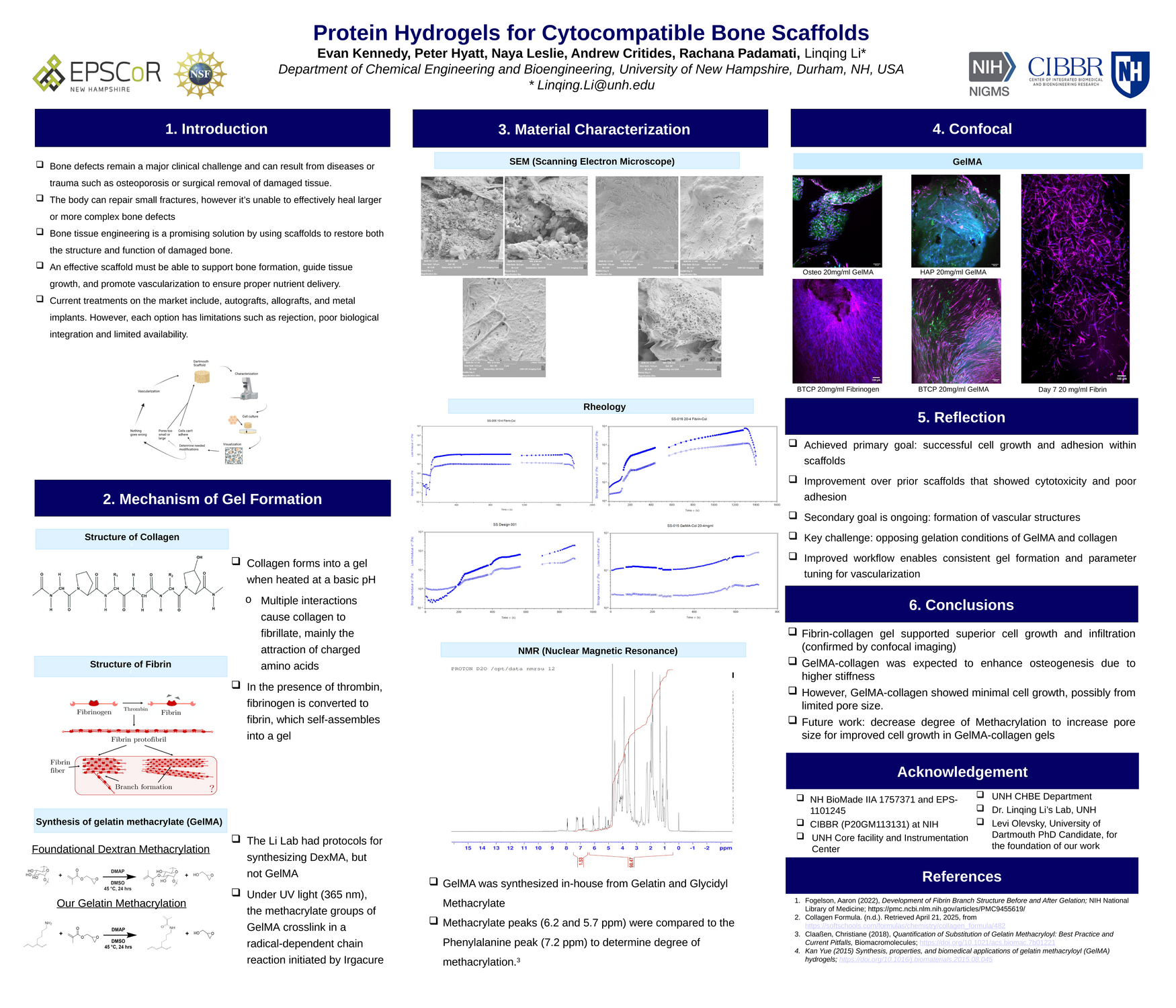
Protein Hydrogels for Cytocompatible Bone Scaffolds
Poster
Preview Converted Images may contain errors
Abstract
Bone defects resulting from trauma, osteoporosis, infection, congenital malformation, or surgical resection of diseased tissue remains a significant clinical challenge. Bones possess inherent regenerative potential; however, this capacity is limited in cases of large or clinically complex defects. The aim of this research was to employ a hybrid biomimetic scaffold structure, designed by Dartmouth PhD student Levi Olevski, to generate an in vitro model that supports vascularization and osteogenesis. Scaffold geometries were evaluated using two cylindrical geometries: The original full-height gyroid lattice design and a reduced-height version developed to improve hydrogel infiltration. Scaffold compositions included hydroxyapatite (HAP), β-tricalcium phosphate (β-TCP), and Osteolite (HAP + wollastonite resin). The scaffolds were infiltrated with GelMA-collagen or fibrin-collagen hybrid hydrogels at concentrations of 10, 20, and 30 mg/mL. Hydrogel seeding was initially performed with human dermal fibroblasts (HDFs) alone to test viability, then the scaffolds were seeded with a triculture of human mesenchymal stem cells (hMSCs), human endothelial cells (HUVECs), and HDFs. Scaffold performance was assessed by imaging and material characterization to compare structural integrity, gel infiltration, and cell viability across different scaffold geometries, compositions, and hydrogel formulations. The results showed that cells remained viable on scaffolds by confocal imaging, with the fibrin-collagen hydrogels supporting a much greater cellular coverage than GelMA-collagen gels. No vascularization or osteogenesis was achieved during this research, in part due to hMSC differentiation attempts failing in both separate culture and when seeded on the scaffolds. These findings support the idea that the current scaffold system can support cell survival, but further optimization is necessary to achieve a fully functional osteogenic and vascularized outcome. Future work will evaluate osteogenic mineral deposition with Alizarin Red S staining. It is hypothesized that reducing the degree of methacrylation may increase microporosity, thus improving cellular infiltration.
Authors
| First Name |
Last Name |
|
Evan
|
Kennedy
|
|
Rachana
|
Padamati
|
|
Peter
|
Hyatt
|
|
Naya
|
Leslie
|
|
Andrew
|
Critides
|
Leave a comment
Submission Details
Conference URC
Event Interdisciplinary Science and Engineering (ISE)
Department Chemical Engineering and Bioengineering (ISE)
Group Chemical Engineering & Bioengineering - Group B
Added April 20, 2026, 5:50 p.m.
Updated April 20, 2026, 5:52 p.m.
See More Department Presentations Here