Title:
Outside Looking In: Cellular Membrane Visualization For Labile Iron Detection
Poster
Preview Converted Images may contain errors
Abstract
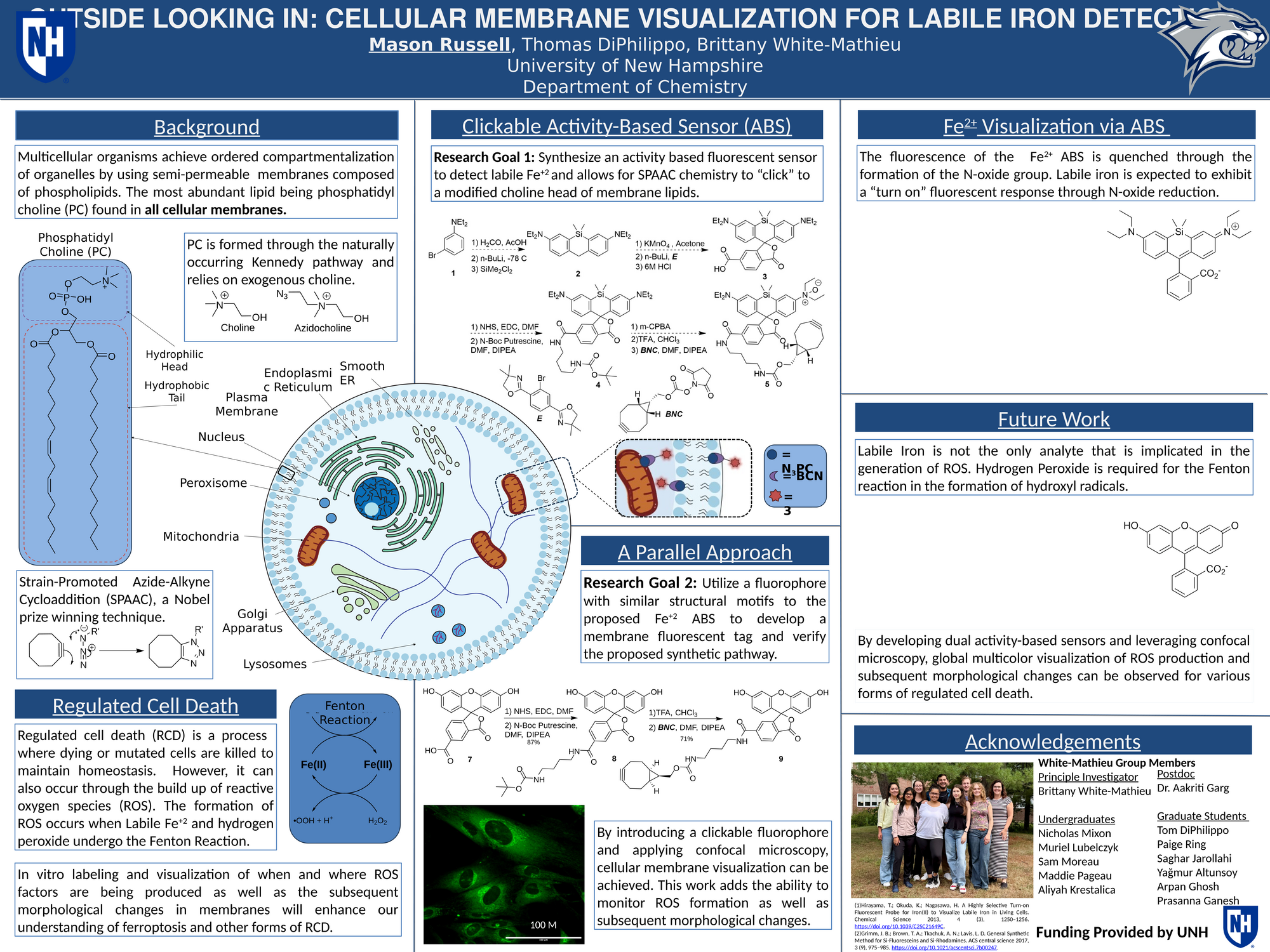
A hallmark of multicellular organisms is the compartmentalization achieved through cellular membranes composed of phospholipid bilayers. The most common phospholipid is phosphatidyl choline (PC), found in all cellular membranes. Through a natural biosynthetic pathway, a modified choline can be introduced into membranes. By introducing an azide group to the hydrophilic region of the lipid, strain-promoted azide-alkyne cycloaddition (SPAAC) can be used. The breakdown of lipid bilayers coincides with regulated cell death (RCD) occurring in a cell. A form of RCD called ferroptosis occurs through the buildup of reactive oxygen species. During Ferroptosis, labile iron (II) proceeds through the Fenton Reaction which produces excess ROS. The buildup of ROS factors causes lipid peroxidation and the breakdown of cellular membranes. The current understanding of this process is limited, which could be improved through the development of a fluorescent activity-based sensor (ABS) for iron (II) and global visualization of when and where ROS are produced with respect to membranes. Previously completed was development of a fluorescent tag with a SPAAC capable functional handle and a similar structure to the proposed ABS. Current work focuses on synthesis of the complete ABS exhibiting a turn-on fluorescence response, and future work includes visualization using confocal microscopy.
Authors
| First Name |
Last Name |
|
Mason
|
Russell
|
Advisors:
| Full Name |
|
Brittany White-Mathieu
|
Leave a comment
Submission Details
Conference URC
Event Interdisciplinary Science and Engineering (ISE)
Department Chemistry (ISE)
Group Chemistry Research
Added April 20, 2026, 4:55 p.m.
Updated April 20, 2026, 4:56 p.m.
See More Department Presentations Here