Title:
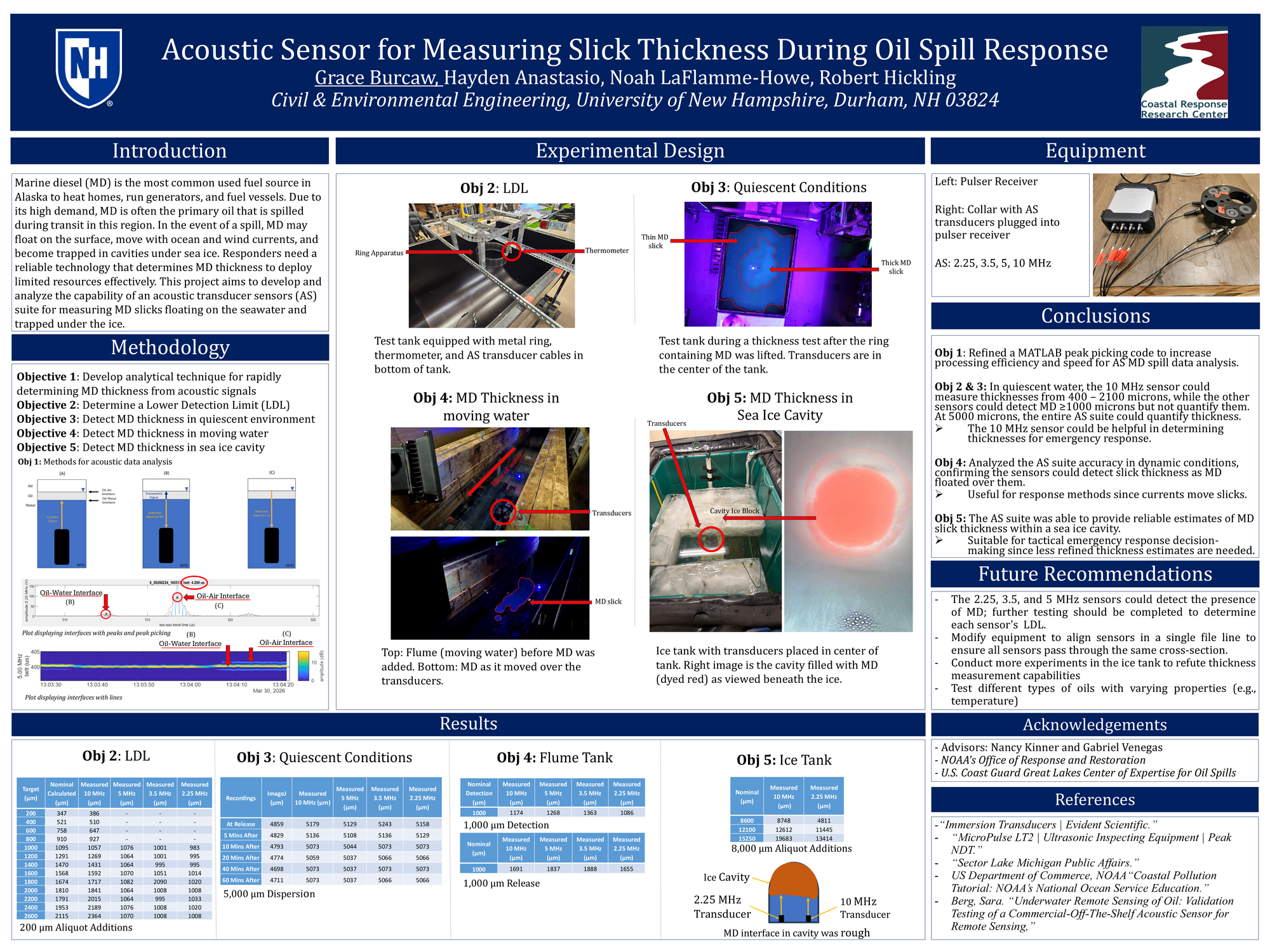
Acoustic Sensor for Measuring Slick Thickness During Oil Spill Response
Poster
Preview Converted Images may contain errors
Abstract
By knowing the thickness of floating oil, responders can determine the volume of oil in water and decide when to deploy skimmers for cleanup. The objective of this project is to test an acoustic sensor suite in a variety of tanks that simulate environmental conditions to evaluate their potential as an aid in oil spill response. Four Olympus Immersion transducers were tested in conjunction with a Peak NDT Micropulse LT2 to determine a lower detection limit (LDL) in a control tank. The 10 MHz sensor detected oil slicks at 200 microns (µm), showing promise as an option to measure in situ slick thickness. The 5, 3.5, and 2.25 MHz sensors detected oil slicks larger than 1000 µm, indicating they may be viable options for oil detection but not for quantifying slicks typically found on the water’s surface. After determining the LDL of the suite, the sensors were tested in a flume tank to simulate wave-like conditions and an ice tank to test the ability of the sensors to detect thickness in Arctic Conditions. This project continues ongoing projects at the Coastal Response Research Center (CRRC) based in Gregg Hall at the University of New Hampshire.
Authors
| First Name |
Last Name |
|
Noah
|
LaFlamme-Howe
|
|
Robert
|
Hickling
|
|
Grace
|
Burcaw
|
|
Hayden
|
Anastasio
|
Advisors:
| Full Name |
|
Gabriel R. Venegas
|
|
Nancy Kinner
|
Leave a comment
Submission Details
Conference URC
Event Interdisciplinary Science and Engineering (ISE)
Department Civil & Environmental Engineering (ISE)
Group Civil and Environmental Engineering- Group C
Added April 20, 2026, 4:42 p.m.
Updated April 20, 2026, 4:44 p.m.
See More Department Presentations Here