Title:
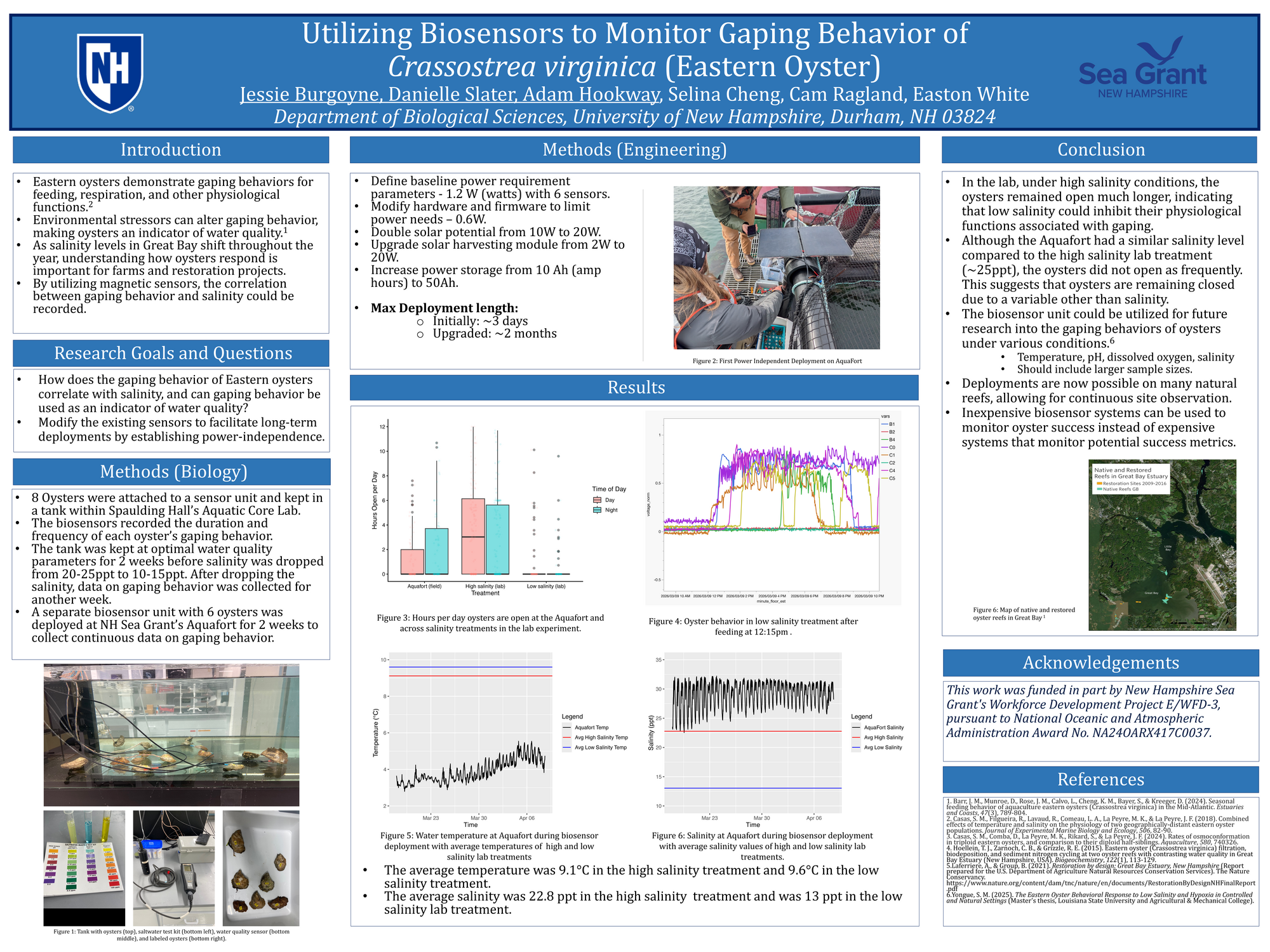
Utilizing Biosensors to Monitor Gaping Behavior of Crassostrea virginica (Eastern Oyster)
Poster
Preview Converted Images may contain errors
Abstract
Eastern oysters (Crassostrea virginica) open their valve for feeding, respiration, and other physiological functions. Gaping behavior is altered when exposed to environmental stressors, making them useful indicators of shifting water quality. This study examined how salinity influences gaping behavior using magnetic biosensors in laboratory and field settings. In the lab, oysters were monitored under baseline salinity (20–25 ppt) for 2 weeks, followed by a reduction to 10–15 ppt for 1 week. A second system was deployed at the NH Sea Grant Aquafort for continuous field monitoring over 2 weeks. Gaping duration and frequency were quantified across treatments. Engineering modifications reduced power consumption from 1.2 W to 0.6 W and increased solar and battery capacity, extending deployment time from 3 days to 2 months. Results showed increased gaping activity under high salinity in the lab, but not in the field, despite the similar salinity levels. With the improved biosensors, future studies could evaluate how gaping behavior is impacted by a variety of environmental conditions. The results derived from this study could be utilized by oyster restoration projects in order to further understand oyster physiology.
Authors
| First Name |
Last Name |
|
Adam
|
Hookway
|
|
Danielle
|
Slater
|
|
Jessie
|
Burgoyne
|
Advisors:
| Full Name |
|
Cam Ragland
|
|
Easton Radley White
|
|
Selina Cheng
|
Leave a comment
Submission Details
Conference URC
Event Interdisciplinary Science and Engineering (ISE)
Department Ocean Engineering (ISE)
Group Ocean Engineering
Added April 20, 2026, 2:12 p.m.
Updated April 20, 2026, 2:13 p.m.
See More Department Presentations Here