Title:
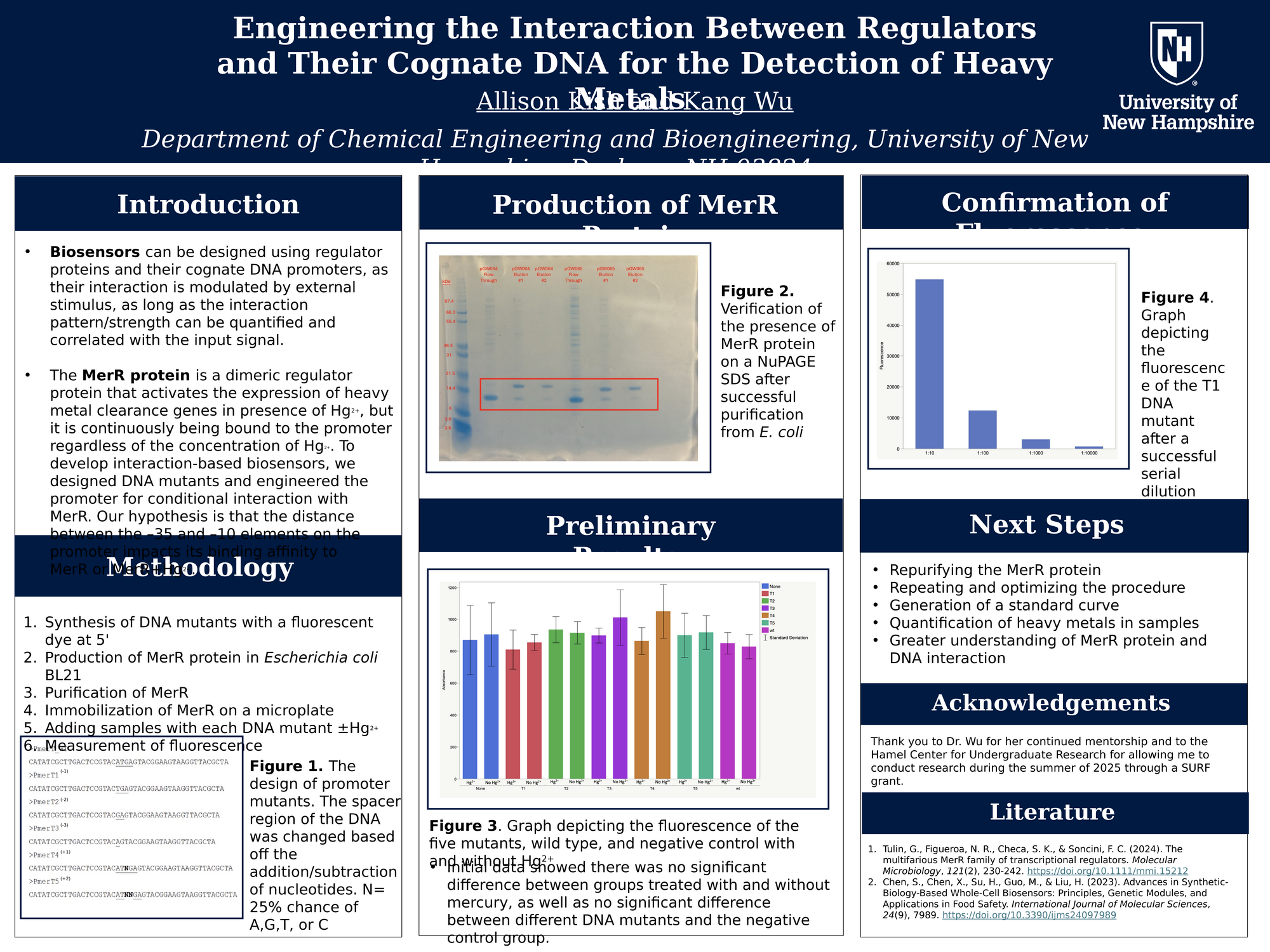
Engineering the Interaction Between Regulators and Their Cognate DNA for the Detection of Heavy Metals
Poster
Preview Converted Images may contain errors
Abstract
Due to their high specificity and relatively inexpensive cost, a variety of whole bacterial cell biosensors are being developed for the detection of compounds such as heavy metals and antibiotics. However, these biosensors typically rely on cell growth and the expression of the reporters, leading to high noise levels and an inability to quantify results. We aim to develop biosensors based on the interaction of the protein regulators and their cognate DNA partners to avoid the step of cell culture and protein expression and enable quantitative detection. However, many protein regulators take a conformation change in response to the analyte but always bind to the DNA. In other words, the protein and DNA always interact to form a complex regardless of the analyte. One example is the heavy metal binding proteins, MerR family regulators. In this project, we will design DNA mutants with dyes that have different affinity to the MerR proteins in response to the heavy metals and develop a standard curve between the dye intensity of the heavy metal concentrations. This will provide a novel method for developing biosensors, not limited to heavy metal detection, but allows the rapid, inexpensive detection of a broader range of chemicals.
Authors
| First Name |
Last Name |
|
Kang
|
Wu
|
|
Allison
|
Kish
|
Leave a comment
Submission Details
Conference URC
Event Interdisciplinary Science and Engineering (ISE)
Department Chemical Engineering and Bioengineering (ISE)
Group Chemical Engineering & Bioengineering - Group A
Added April 20, 2026, 10:14 a.m.
Updated April 20, 2026, 10:14 a.m.
See More Department Presentations Here