Title:
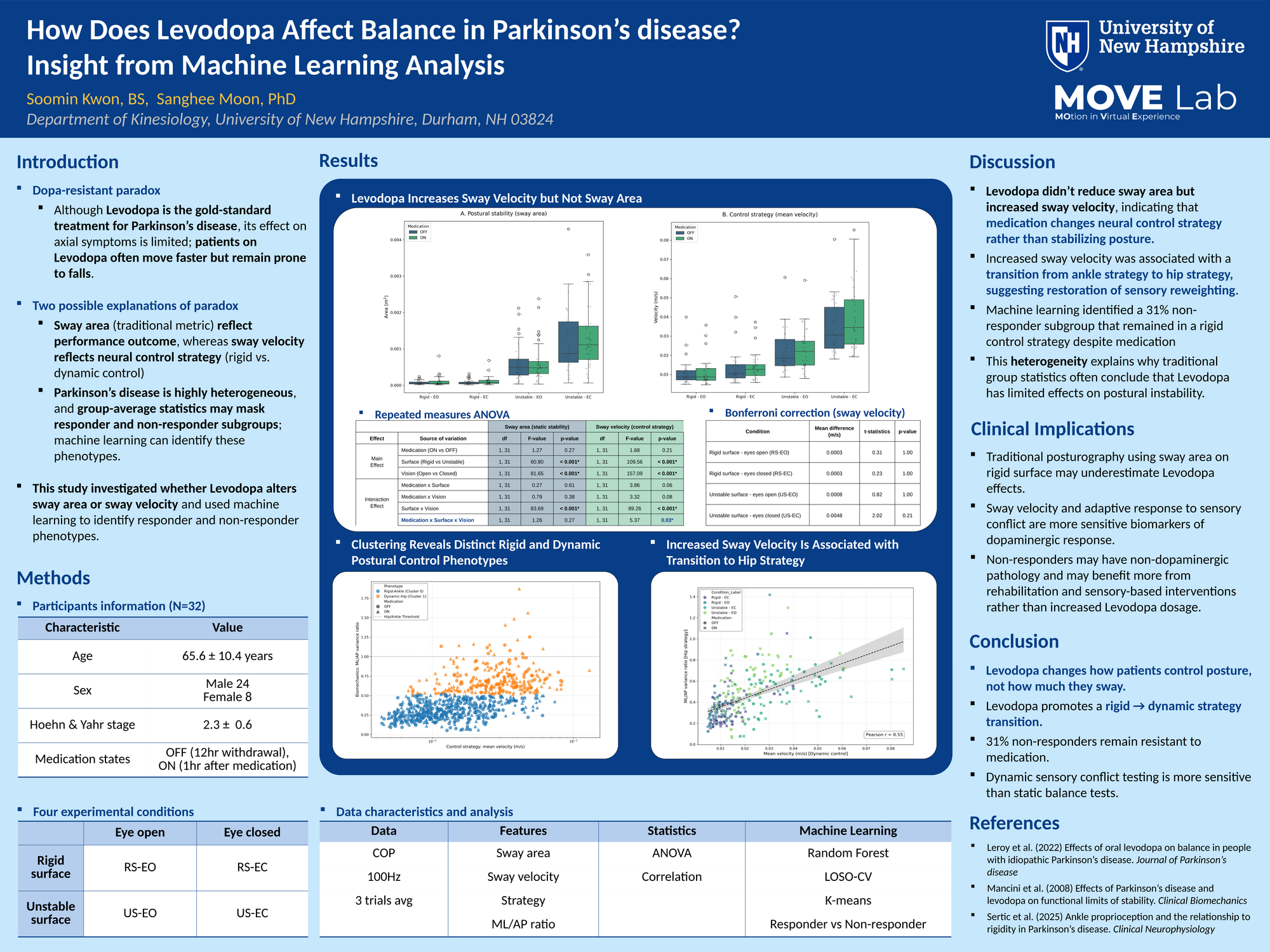
How Does Levodopa Affect Balance in Parkinson’s disease? �Insight from Machine Learning Analysis
Poster
Preview Converted Images may contain errors
Abstract
Background: Levodopa is the gold standard treatment for Parkinson's disease (PD), yet its effect on postural instability remains inconsistent. Traditional posturography relies on static sway area, which may fail to capture the underlying neural control policy for postural control.
Purpose: To determine whether Levodopa alters postural sway quantity (sway area) or quality (sway velocity) during sensory conflict, and to identify heterogeneous therapeutic response phenotypes in PD.
Methods: Thirty-two individuals with PD were assessed in ON and OFF medication states across four sensory conditions (rigid/unstable surface x eyes open/closed). Sway area and mean velocity were extracted. Repeated measures ANOVA examined medication effects. A random forest classifier predicted medication state using velocity-based features. K-means clustering identified distinct postural phenotypes using mean velocity and the mediolateral/anteroposterior variance ratio.
Results: Levodopa did not reduce sway area (p=0.27), but produced a significant medication x surface x vision interaction for mean velocity (p=0.03). The random forest classifier predicted medication state with 65.6% accuracy (AUC=0.63), with unstable-surface velocity as the strongest predictor. Increased sway velocity was moderately correlated with a shift toward hip-dominant control (r=0.55, p<0.001). K-means clustering revealed rigid-ankle and dynamic-hip postural phenotypes, with 31% of ON-state trials remaining in the rigid-ankle cluster, representing a dopa-resistant subgroup.
Conclusion: Levodopa facilitates a transition from rigid to dynamic postural control rather than improving static stability. A non-responder subgroup (31%) suggests non-dopaminergic pathophysiology underlies persistent postural instability in a subset of patients. Dynamic sensory-conflict assessments paired with phenotypic classification are critical for evaluating Levodopa's therapeutic impact on postural control.
Authors
| First Name |
Last Name |
|
Sanghee
|
Moon
|
|
Soomin
|
Kwon
|
Leave a comment
Submission Details
Conference GRC
Event Graduate Research Conference
Department Kinesiology (GRC)
Group Teaching Excellence and Scholarship
Added April 15, 2026, 12:34 p.m.
Updated April 15, 2026, 12:35 p.m.
See More Department Presentations Here