Title:
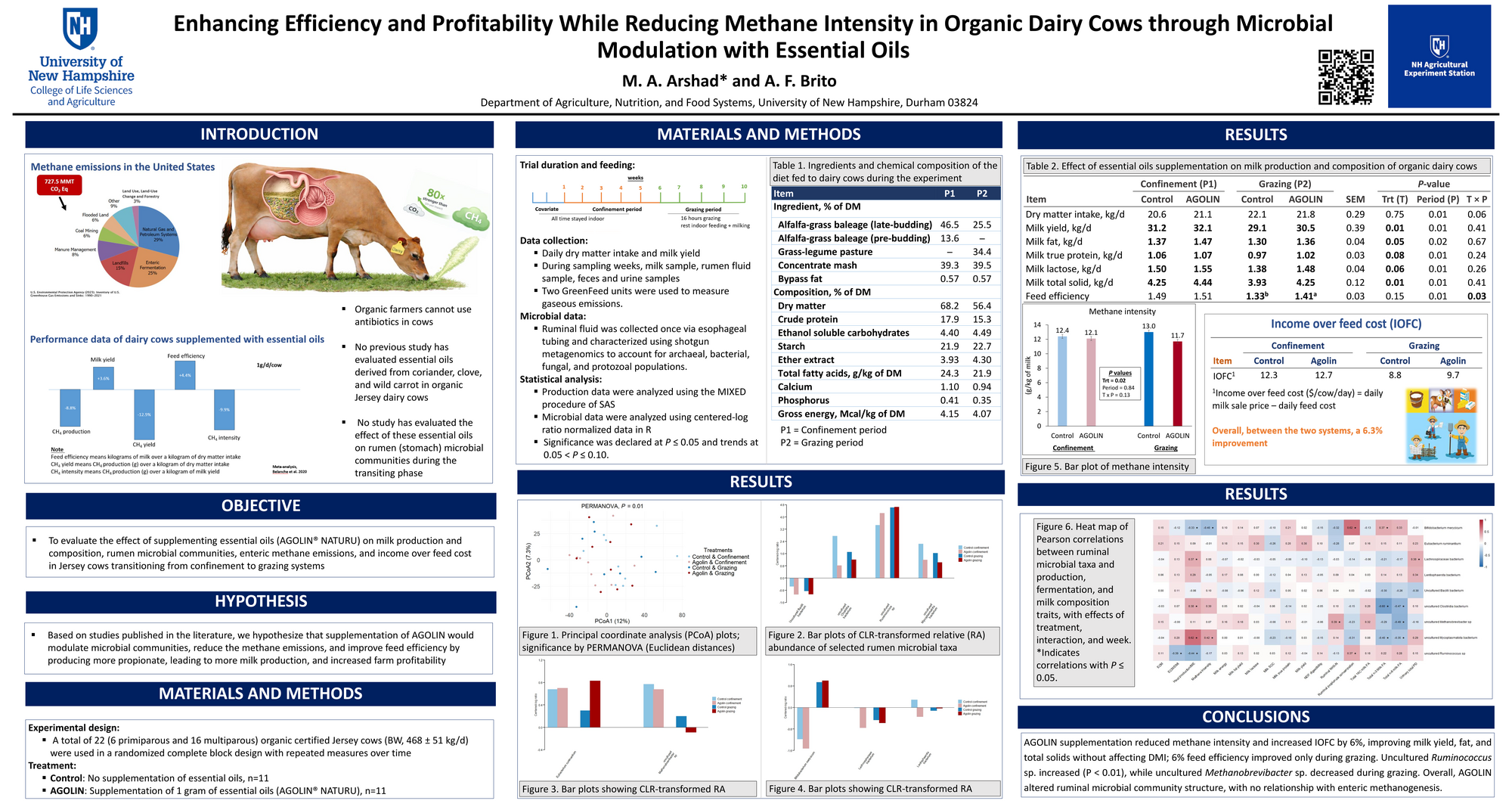
Enhancing Efficiency and Profitability While Reducing Methane Intensity in Organic Dairy Cows through Microbial Modulation with Essential Oils
Poster
Preview Converted Images may contain errors
Abstract
Methane emissions from dairy cows contribute to environmental concerns and reduce feed efficiency by diverting energy away from milk production. In the United States, enteric fermentation accounts for ~25% of total methane emissions, posing a particular challenge for organic dairy systems where synthetic additives and antibiotics are not permitted. Essential oils offer a natural alternative. A meta-analysis showed that supplementing 1 g/d per cow of a blend derived from wild carrot, coriander, and clove improved milk production, feed efficiency, and reduced methane emissions under confinement. However, their effects in organic cows transitioning from confinement to grazing remain unknown. Therefore, this study evaluated the effects of Agolin® NATURU supplementation on production performance, rumen microbial communities, methane emissions, and income over feed cost. A total of 22 Jersey cows were assigned to a randomized complete block design with two treatments: Control and AGOLIN (1 g/d). The 12-week trial included a 2-week covariate period followed by 5 weeks of confinement and 5 weeks of grazing, with pasture replacing ~35% of forage during grazing. Data included milk production, gaseous emissions, and rumen samples analyzed using shotgun metagenomics. Production data were analyzed using SAS, and microbial data were CLR-transformed and analyzed in R. A treatment × week interaction was observed for β-diversity (PERMANOVA, P = 0.01), indicating shifts in microbial community composition over time. PCoA showed substantial overlap among groups, although Agolin-supplemented cows during confinement appeared slightly more clustered. Differential abundance analysis showed a treatment × period interaction, where Agolin decreased the abundance of Methanobrevibacter spp. and increased Eubacterium ruminantium relative to the control in grazing. In addition, Agolin supplementation increased the abundance of uncultured Ruminococcus spp., while reducing uncultured Bacilli, Clostridia, and Mycoplasmatota. Regarding period effects, grazing was associated with a greater abundance of Bifidobacterium merycicum and reduced abundance of Lachnospiraceae and Lentisphaerae compared with confinement. Agolin reduced methane intensity and increased income over feed cost by ~6%, while improving milk yield (+4%), milk fat (+6%), and total solids (+6%) without affecting DMI. Feed efficiency improved by 6% during grazing. Correlations between microbial taxa and production traits were weak to moderate (−0.60 to 0.62). Ruminococcus spp. were positively associated with ruminal molar proportion of propionate and negatively with heat production, whereas Mycoplasmatota and Methanobrevibacter were positively associated with methane-related traits. Bifidobacterium merycicum was negatively associated with methane intensity and positively associated with propionate. Overall, Agolin supplementation induced targeted microbial shifts associated with reduced methane intensity and improved energetic efficiency.
Authors
| First Name |
Last Name |
|
Andre
|
Brito
|
|
Muhammad Adeel
|
Arshad
|
Leave a comment
Submission Details
Conference GRC
Event Graduate Research Conference
Department Agricultural Sciences (GRC)
Group Strengthening UNH's Impact Through Sustainability
Added April 15, 2026, 12:27 p.m.
Updated April 15, 2026, 12:28 p.m.
See More Department Presentations Here