Title:
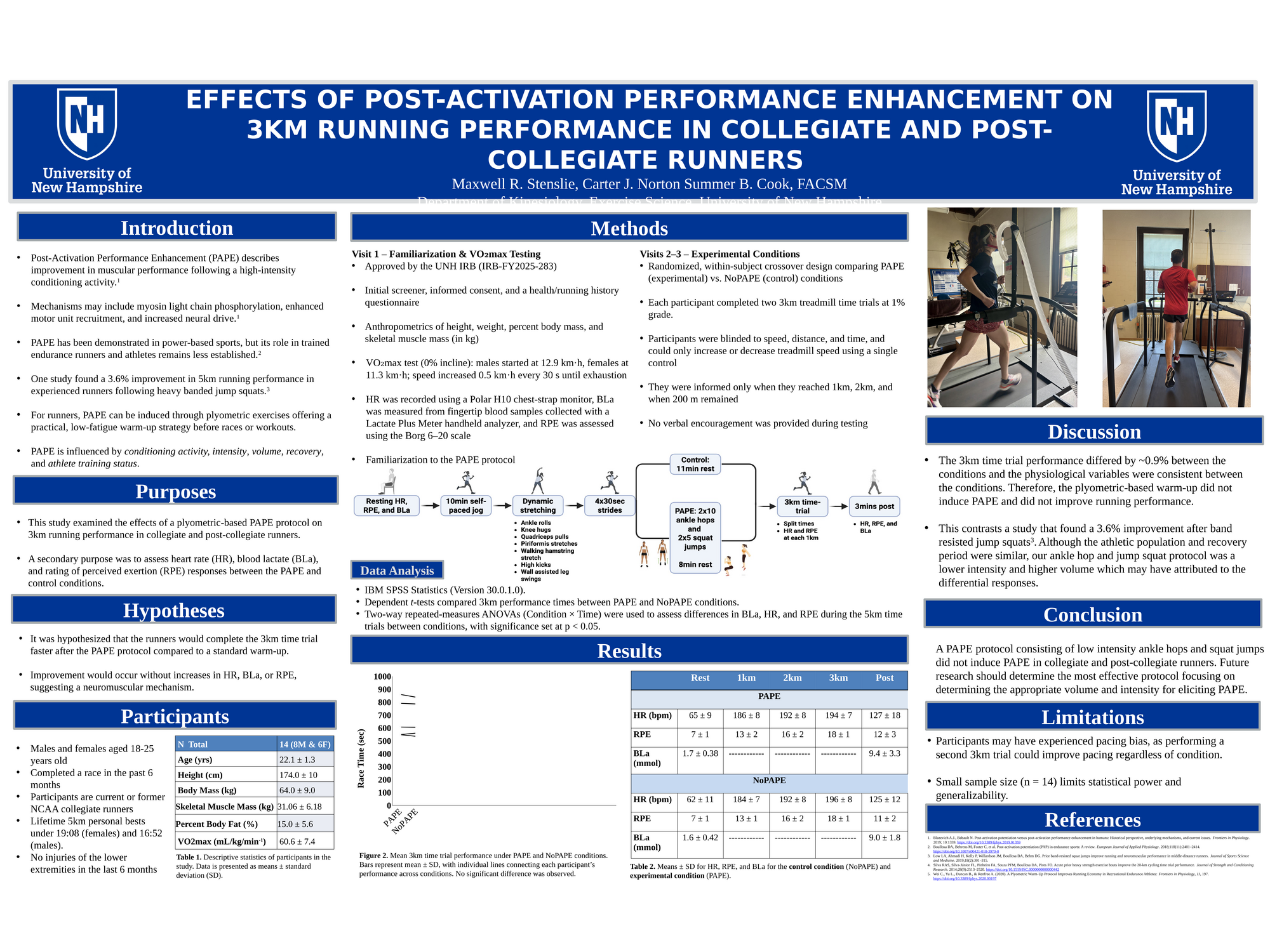
Effects of Post-Activation Performance Enhancement on 3km Running Performance in Collegiate and Post-Collegiate Runners
Poster
Preview Converted Images may contain errors
Abstract
Post-Activation performance enhancement (PAPE) is the acute improvement in voluntary performance following a plyometric or strength-based conditioning activity. While observed in power sports, the potential of PAPE to enhance running performance in high-level endurance runners remains to be determined. PURPOSE: This study examined whether a plyometric-based PAPE protocol could improve 3km running performance in collegiate and post-collegiate runners. METHODS: Six collegiate and post-collegiate runners (5 males and 1 female; 21.3±1.2 yrs; 68.2±9.6 kg; 1.77±0.09 m; V̇O₂max 60.6 ± 3.0 ml·kg⁻¹·min⁻¹) completed two 3-km time trials under PAPE and control (NoPAPE) conditions. The PAPE condition consisted of two sets of 10 ankle hops and 5 squat jumps following a standardized warm-up, whereas the NoPAPE condition included the warm-up alone. An 8-min rest interval after the PAPE protocol and an 11-min rest interval after the NoPAPE condition were provided prior to beginning the 3-km run. Split times were recorded at each kilometer, and total performance time served as the primary outcome. Secondary measures included blood lactate concentration, heart rate, and rating of perceived exertion (RPE, Borg 6–20), assessed immediately before and after each trial. Repeated measures analysis of variance and dependent t-tests were used to analyze the data. RESULTS: Cumulative time trial did not differ between PAPE and NoPAPE (11:00±95s vs 10:54±89s; p=0.134; d= -0.309, respectively). There were no differences in blood lactate (p=0.705; η²=0.011), HR (p=0.334; η²=0.083), RPE (p=0.825; η²=0.028) between the two conditions. CONCLUSION: A plyometric-based PAPE protocol was not effective in improving 3-km running performance in collegiate and post-collegiate runners. Future research should explore whether manipulating the intensity of the conditioning activity or adjusting rest interval length could produce different PAPE responses in endurance running. Clarifying the role of PAPE in endurance running may help guide the design of future warm-up strategies for competitive distance runners.
Authors
| First Name |
Last Name |
|
Summer
|
Cook
|
|
Carter
|
Norton
|
|
Maxwell
|
Stenslie
|
Leave a comment
Submission Details
Conference GRC
Event Graduate Research Conference
Department Kinesiology (GRC)
Group Interdisciplinary Research
Added April 14, 2026, 12:51 p.m.
Updated April 14, 2026, 12:52 p.m.
See More Department Presentations Here