Title:
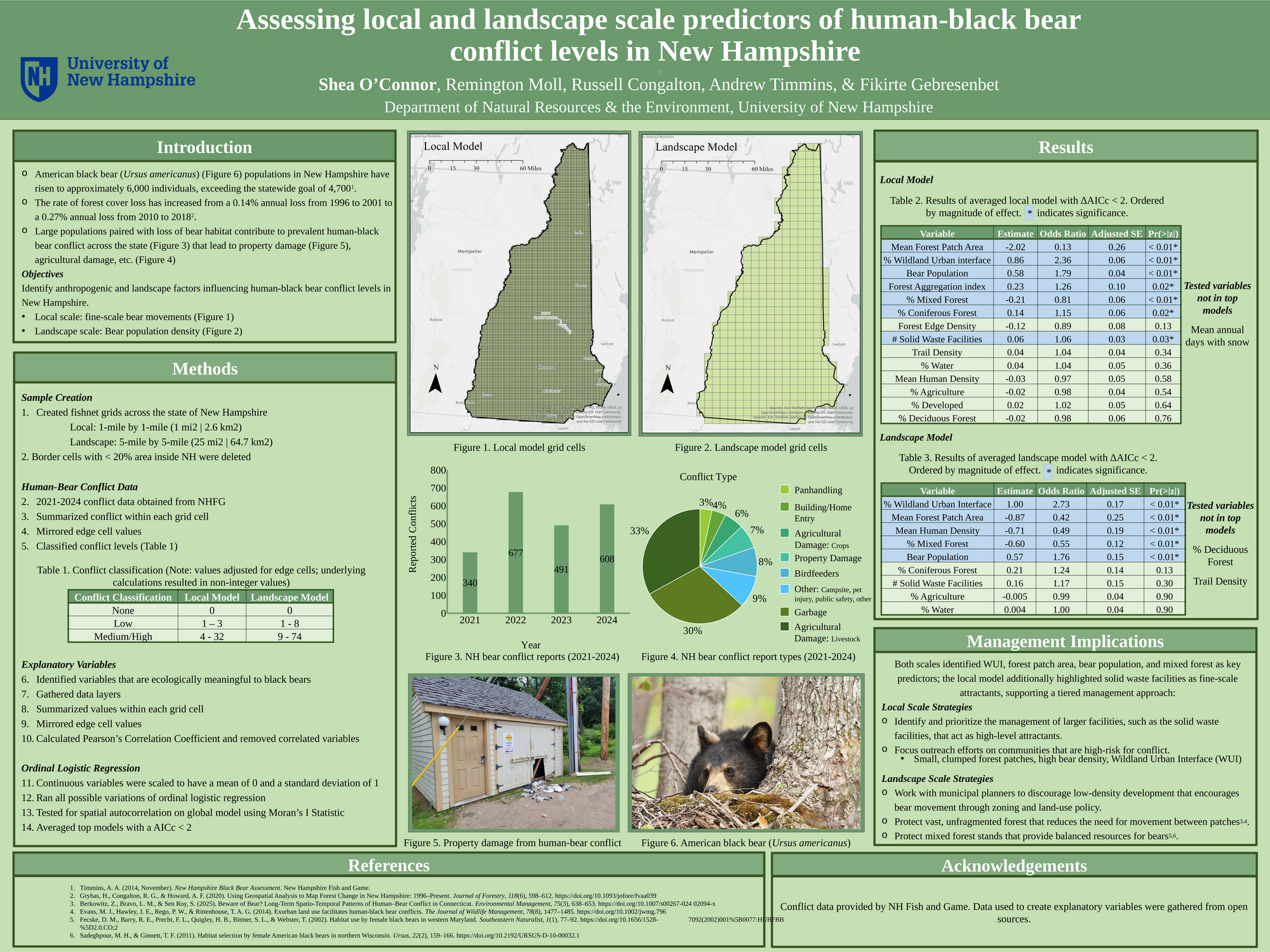
Assessing local and landscape scale predictors of human-black bear conflict intensity in New Hampshire
Poster
Preview Converted Images may contain errors
Abstract
American black bear (Ursus americanus) populations in New Hampshire have risen to approximately 6,000 individuals, exceeding the statewide goal of 4,700. Large populations paired with increasing human development contribute to prevalent human-black bear conflict across the state. This study aimed to identify anthropogenic and landscape factors influencing human-black bear conflict intensity. Ordinal logistic regression was utilized to analyze 2,033 confirmed conflict reports from 2021-2024 summarized in local (1 mi2 | 2.6 km2) and landscape (25 mi2 | 64.7 km2) scale grids to identify key anthropogenic and environmental drivers. Results indicate that the percentage of Wildland Urban Interface (WUI) was a primary positive driver of conflict intensity at both scales. Bear population was also found to have a significant positive relationship with conflict intensity. Larger mean forest patches and higher percentages of mixed forest significantly reduced conflict odds by providing adequate natural resources. Other significant factors at the local scale included the number of solid waste facilities present and forest aggregation index. These findings suggest that effective management requires a hierarchical strategy that protects large, unfragmented mixed forest patches while implementing targeted attractant management at large facilities and focusing community outreach in areas displaying characteristics of high conflict intensity.
Authors
| First Name |
Last Name |
|
Fikirte
|
Gebresenbet
|
|
Andrew
|
Timmins
|
|
Russell
|
Congalton
|
|
Remington
|
Moll
|
|
Shea
|
O'Connor
|
Leave a comment
Submission Details
Conference GRC
Event Graduate Research Conference
Department NREN (GRC)
Group Teaching Excellence and Scholarship
Added April 11, 2026, 11:02 a.m.
Updated April 11, 2026, 11:05 a.m.
See More Department Presentations Here