Title:
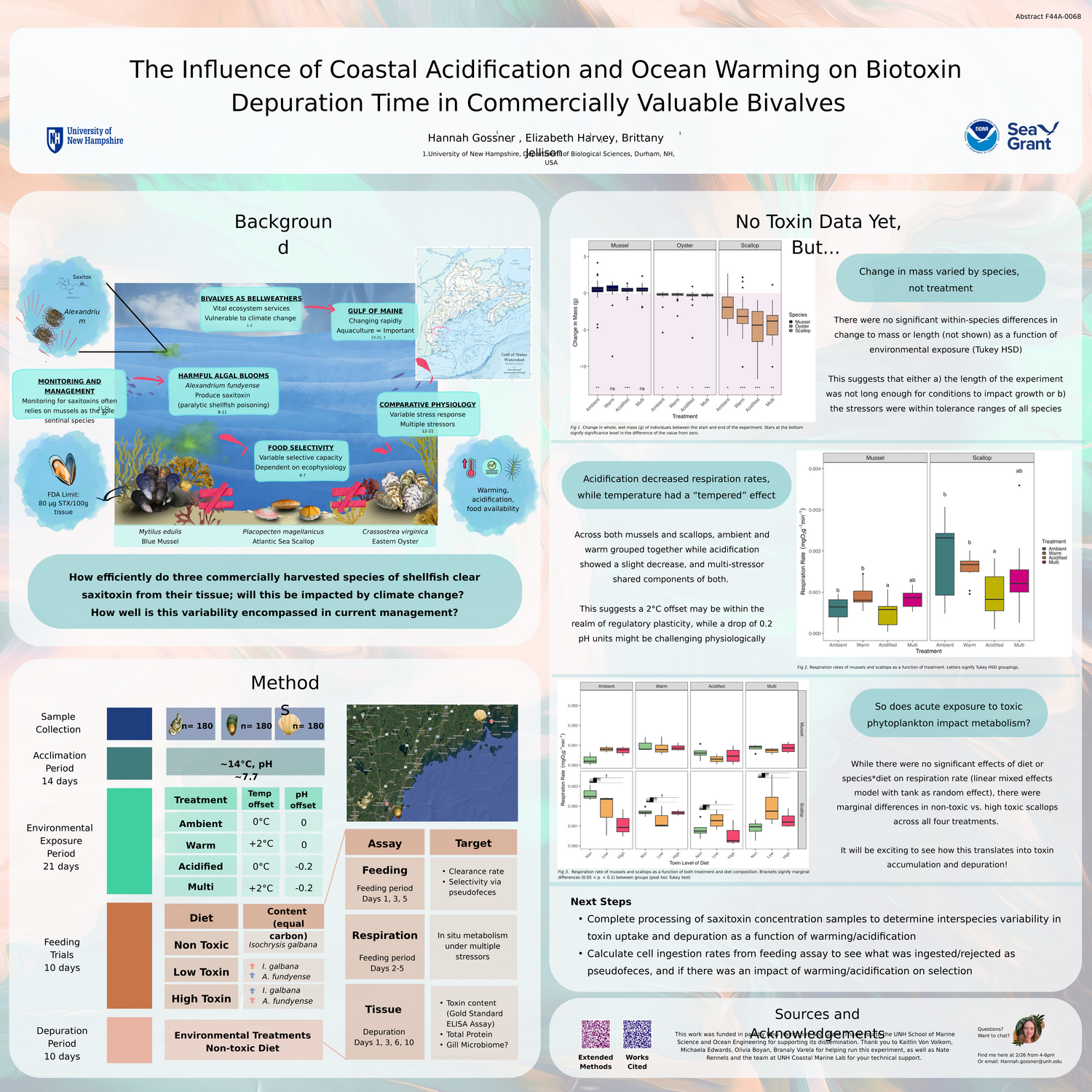
The Influence of Coastal Acidification and Ocean Warming on Biotoxin Depuration Time in Commercially Valuable Bivalves
Poster
Preview Converted Images may contain errors
Abstract
As benthic, generally sessile filter feeders, the health of bivalves and the ecosystem are inherently intertwined. These two lifestyle traits, however, make bivalves susceptible to environmental stressors. Their sessile lifestyle reduces the capacity for escape from suboptimal conditions and filter feeding exposes bivalves to a variety of particles, including toxic phytoplankton. Exposure to toxic phytoplankton frequently occurs during Harmful Algal Blooms (HABs). HABs occur nearly annually in the Gulf of Maine (GoME) and are mostly attributed to the dinoflagellate Alexandrium fundyense. A. fundyense produces neurotoxins known as saxitoxins (STX) which can cause Paralytic Shellfish Poisoning (PSP) in humans. Teasing apart the relationship between toxin accumulation, depuration rate, warming, and acidification will provide insight into the effectiveness of current monitoring efforts and help forecast impacts of HABs and climate change on bivalve ecosystem services. In order to do this, this study exposes three species of bivalves- Eastern Oyster Crassostrea virginica, Blue Mussel Mytilus edulis, and Atlantic Sea Scallop Placopecten magellanicus- to a cross of warming and acidification, and measures STX accumulation and depuration.
No Author Information Provided
Leave a comment
Submission Details
Conference GRC
Event Graduate Research Conference
Department DBS- Marine Biology (GRC)
Group Teaching Excellence and Scholarship
Added April 10, 2026, 10:25 a.m.
Updated April 10, 2026, 10:27 a.m.
See More Department Presentations Here