Title:
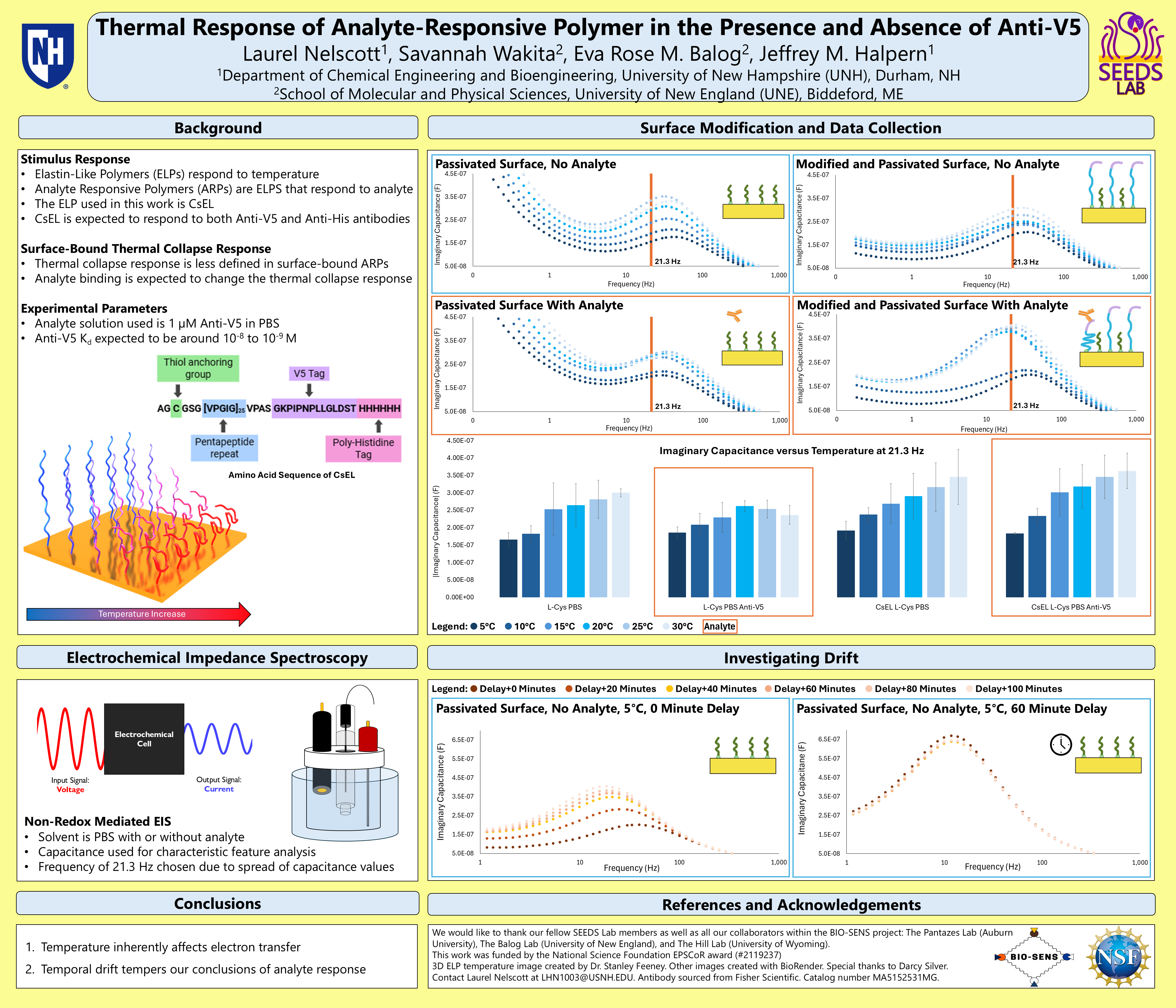
Thermal Response of Analyte-Responsive Polymer in the Presence and Absence of Anti-V5
Poster
Preview Converted Images may contain errors
Abstract
Elastin-like polymers (ELPs) undergo a phase transition in response to temperature and ion concentration, and often include specific binding tags for use in purification. The stimuli-responsive nature of ELPs provides multiple methods to verify their attachment to a surface, and it is theorized that the binding of an antibody to one of the purification tags will trigger a similar response. In this work, gold rod electrodes modified with ELPs are placed into a PBS solution containing either 0 M or 1 uM Anti-V5 antibody which is then raised from a temperature of 5*C to a temperature of 30 *C in increments of 5 degrees. Non redox-mediated electrochemical impedance spectroscopy is used to collect data after the electrode has been allowed to sit for 5 minutes at each temperature. The imaginary capacitance curves are then examined to confirm that the ELP-modified surface behaves differently from a control surface passivated with L-Cysteine, and that the ELP-modified surface behaves differently in the presence and absence of Anti-V5 antibody. While a difference in behavior is observed between the modified and control surfaces, any analyte response exhibited by the surface is covered by the phase transition of the polymer and the inherent effects of temperature on electron transfer.
Authors
| First Name |
Last Name |
|
Jeffrey
|
Halpern
|
|
Eva Rose
|
Balog
|
|
Savannah
|
Wakita
|
|
Laurel
|
Nelscott
|
Leave a comment
Submission Details
Conference GRC
Event Graduate Research Conference
Department Bioengineering (GRC)
Group Strengthening UNH's Impact
Added April 9, 2026, 11:37 a.m.
Updated April 10, 2026, 8:02 a.m.
See More Department Presentations Here