Title:
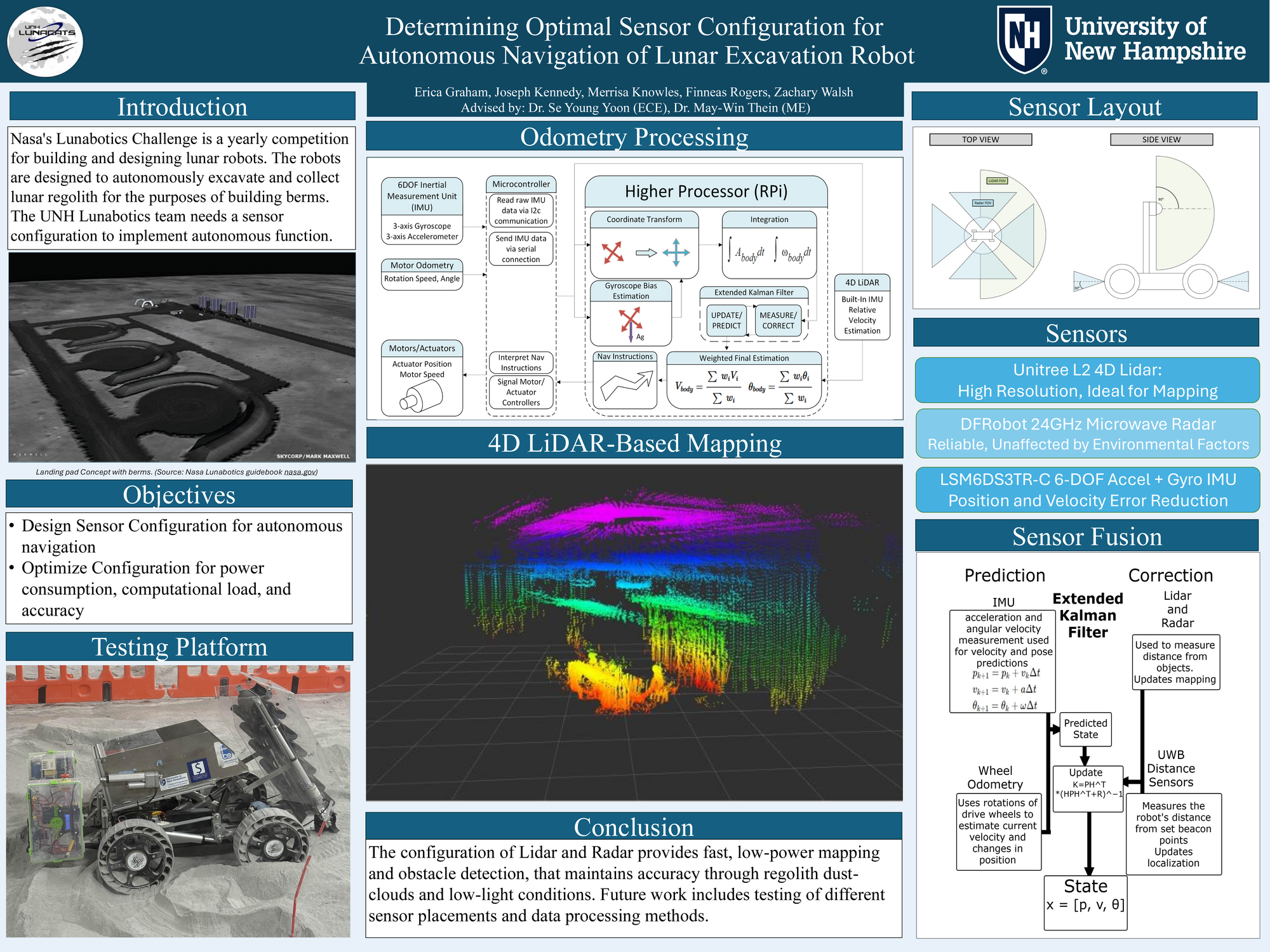
Determining Optimal Sensor Configuration for Autonomous Navigation of Lunar Excavation Robot
Poster
Preview Converted Images may contain errors
Abstract
NASA starts construction of a lunar base in less than two years. Robots play a key role in making extraterrestrial construction and exploration safer and easier, especially those that can do important work on their own, or autonomously. Our group, part of UNH’s Lunabotics team, set out to implement a refined sensor system intended for the remote and autonomous operation of our lunar regolith excavation robot. To optimize our configuration, we adapted literature relating to autonomous vehicles here on Earth into a suite intended to combat the unique environment of the moon.
Our configuration makes use of a main 4D mechanical LiDAR and multiple peripheral millimeter-wave radar devices, fusing the data from all of them to generate a map of the robot’s surroundings to facilitate autonomous navigation and construction. Other commonly used sensors, specifically depth cameras and sonar, were considered. Sonar was discarded because it requires an atmosphere, and depth cameras presented bandwidth issues and the changing light conditions effected reliability of sensor readings
Our work can contribute to the fields of autonomous perception and extraterrestrial robot design. This system can apply to robots with a wide variety of forms and purposes.
Authors
| First Name |
Last Name |
|
Zachary
|
Walsh
|
|
Finn
|
Rogers
|
|
Merrisa
|
Knowles
|
|
Joseph
|
Kennedy
|
|
Erica
|
Graham
|
Advisors:
| Full Name |
|
May-Win Thein
|
|
Se Young Yoon
|
Leave a comment
Submission Details
Conference URC
Event Interdisciplinary Science and Engineering (ISE)
Department Electrical & Computer Engineering (ISE)
Group Electrical and Computer Engineering - Sensing and Action in the Real World
Added April 21, 2026, 12:01 a.m.
Updated April 21, 2026, 12:02 a.m.
See More Department Presentations Here