Title:
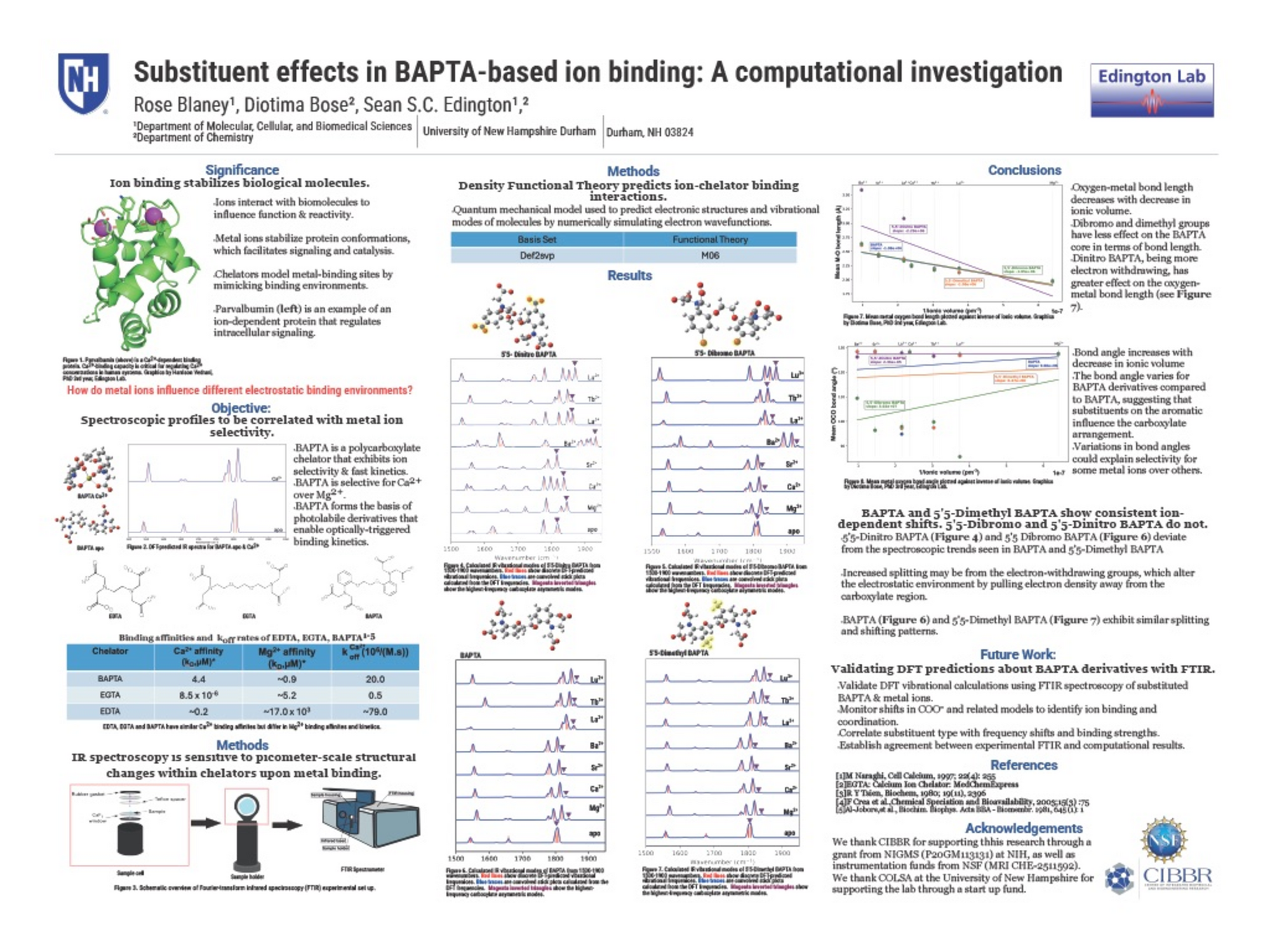
Substituent effects in BAPTA-based ion binding: A computational investigation
Poster
Preview Converted Images may contain errors
Abstract
Ion-binding in proteins is often studied using chelators as model systems. BAPTA is an example chelator that exhibits high Ca²⁺ selectivity and affinity. BAPTA can be substituted with functional groups at its 5 and 5' positions to tune binding properties. Our objective is to investigate how BAPTA derivatives affect the core ion selectivity and spectroscopic response. It has been reported that electron-withdrawing groups decrease, whereas electron-donating groups increase, BAPTA’s Ca²⁺-binding affinity. However, the impact of such groups on the affinity to bind other metal ions remains unknown. Our studies employing density functional theory focus on analyzing computed IR spectra of BAPTA and derivative metal complexes via ion-dependent shifts and splitting of the carboxylate asymmetric stretching mode. Our results suggest that electron-withdrawing groups exert greater influence on binding properties. BAPTA and 5,5’-dimethyl BAPTA exhibit similar patterns. Parameters like OCO mean bond angles and O-Mn⁺ bond lengths indicate variable trends among BAPTA derivatives. These studies highlight the importance of electrostatic effects in modulating ion binding, providing insights into experimental results obtained using infrared spectroscopy.
Authors
| First Name |
Last Name |
|
Rose
|
Blaney
|
Leave a comment
Submission Details
Conference URC
Event Interdisciplinary Science and Engineering (ISE)
Department Chemistry (ISE)
Group Chemistry Research
Added April 20, 2026, 8:18 p.m.
Updated April 20, 2026, 8:18 p.m.
See More Department Presentations Here