Title:
Decellularized Organs as Autologous Alternatives for Tissue Transplantation
Poster
Preview Converted Images may contain errors
Abstract
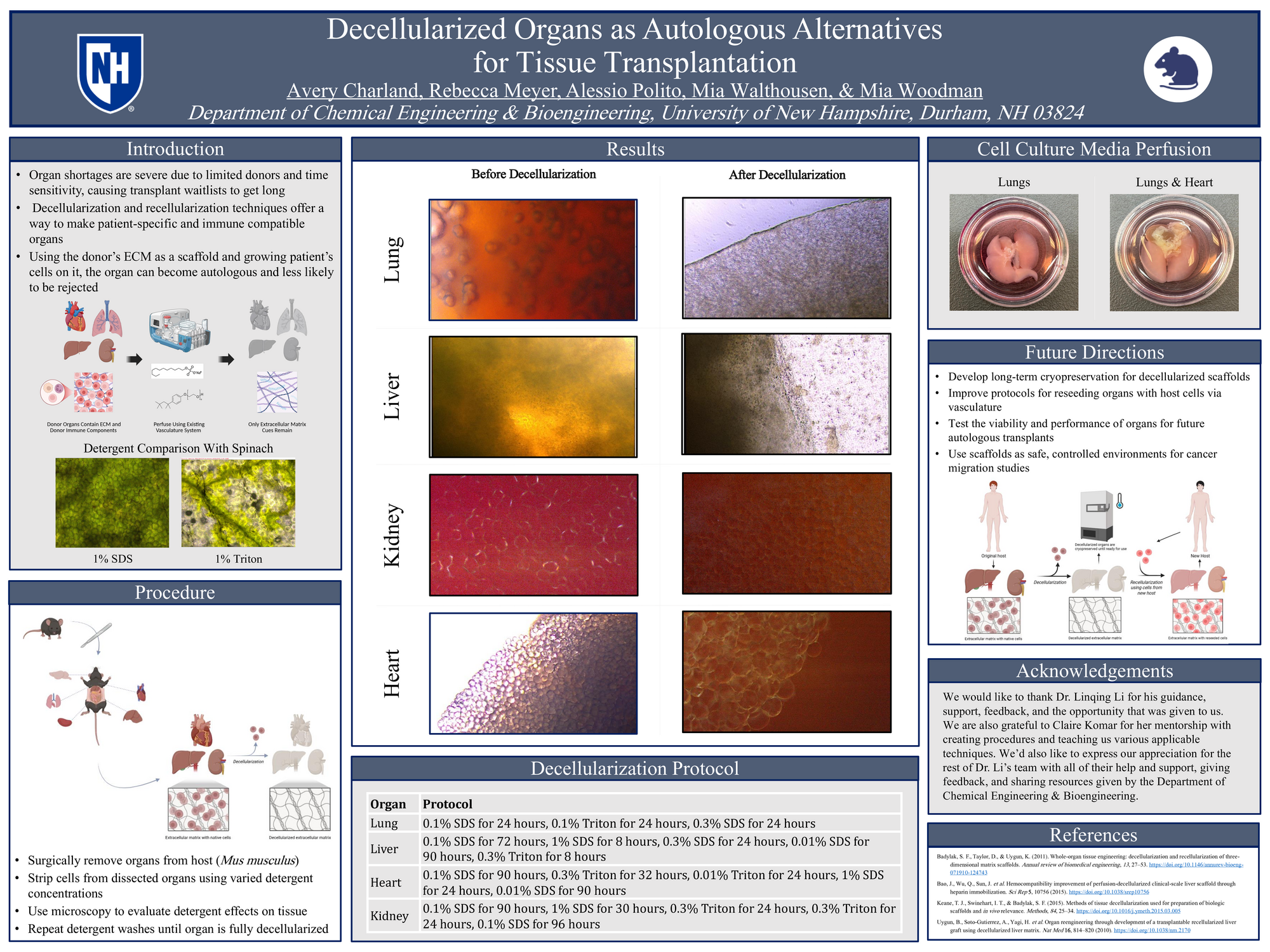
There is a severe organ shortage globally, due to various limiting factors. The viability of donor organs is time-sensitive after procurement, limiting successful transplantation. This opens an opportunity for medical innovation that reduces preservation limits and organ rejection, improving transplant outcomes and shortening waitlists. Decellularization and recellularization of organ tissues offers a way to create patient-specific and immune compatible organs. Using the donor’s extracellular matrix (ECM) as a scaffold and perfusing patient cells into the vasculature, the organ can become autologous, decreasing its chances of the organ being rejected. Starting with mice, the heart, kidney, liver, and the lungs were surgically removed from the mice. Using various concentrations of detergents, cells were stripped from the ECM of these structures. To evaluate the feasibility of the decellularized organs, cell growth and adhesion within the remaining ECM scaffold was tested using donor cells. Looking forward, these efforts hope to contribute to the production of an organ bank system within hospitals. This would allow transplant patients to receive previously decellularized organs that have been recellularized with the patient’s own cells.
Authors
| First Name |
Last Name |
|
Mia
|
Woodman
|
|
Mia
|
Walthousen
|
|
Alessio
|
Polito
|
|
Rebecca
|
Meyer
|
|
Avery
|
Charland
|
Advisors:
| Full Name |
|
Claire Komar
|
|
Linqing Li
|
Leave a comment
Submission Details
Conference URC
Event Interdisciplinary Science and Engineering (ISE)
Department Innovation Scholars (ISE)
Group Innovation Scholars
Added April 20, 2026, 4:36 p.m.
Updated April 20, 2026, 4:38 p.m.
See More Department Presentations Here