Title:
Algorithmic Redistricting
Poster
Preview Converted Images may contain errors
Abstract
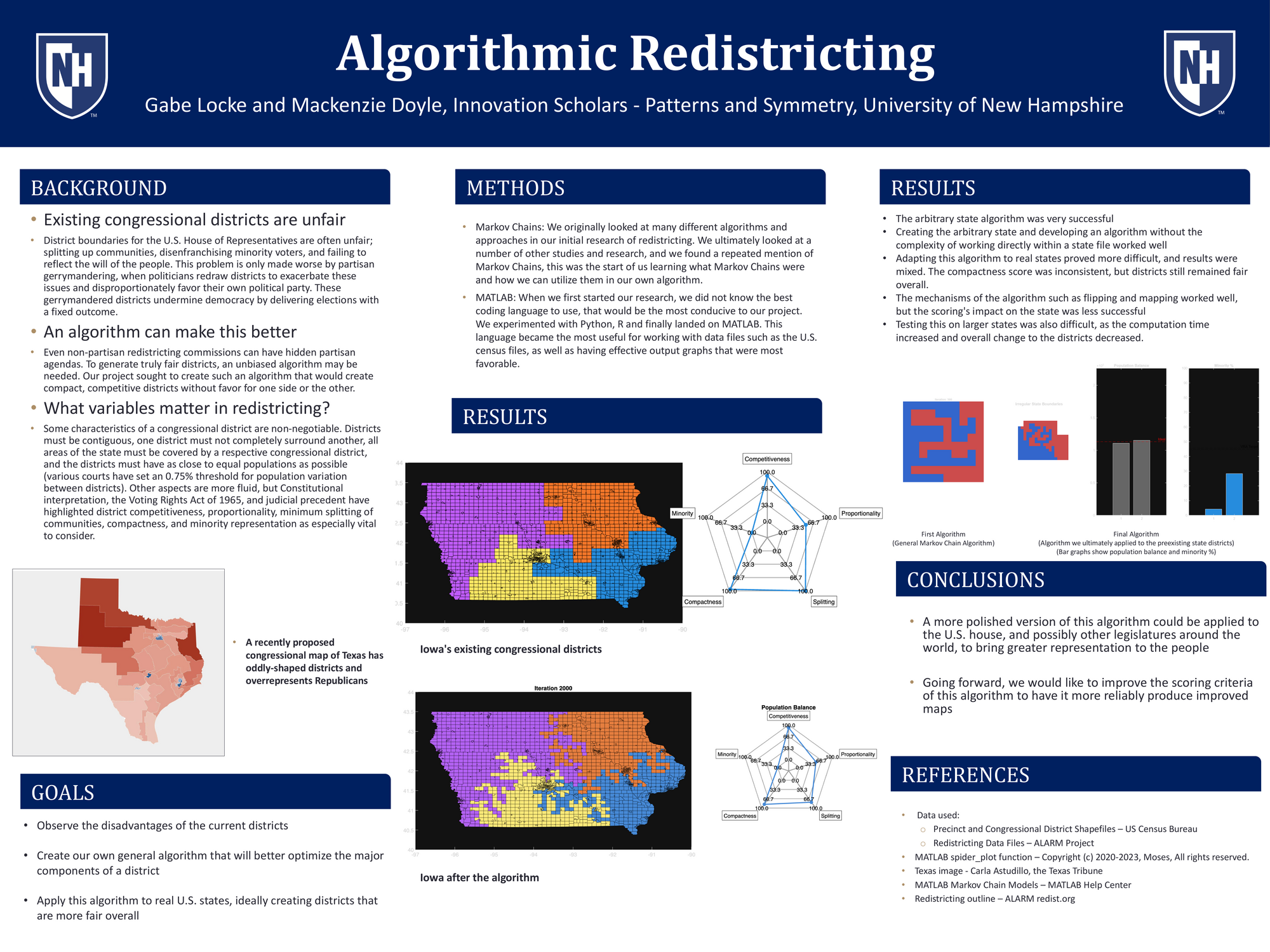
District boundaries for the U.S. House of Representatives are often unfair;
splitting up communities, disenfranchising minority voters, and failing to
reflect the will of the people. This problem is only made worse by partisan
gerrymandering, when politicians redraw districts to exacerbate these
issues and disproportionately favor their own political party. These
gerrymandered districts undermine democracy by delivering elections with
a fixed outcome. Even non-partisan redistricting commissions can have hidden partisan
agendas. To generate truly fair districts, an unbiased algorithm may be
needed. Our project sought to create such an algorithm that would create
compact, competitive districts without favor for one side or the other. We researched markov
chains and applied them towards a redistricting algorithm that took multiple variables into
account, such as compactness of districts and representation of minority voters. While the
actual mechanisms behind the algorithm, such as the changing of the map and analysis of
results, were effective, our calculations taking our variables into account were less-so, delivering
mixed results.
Authors
| First Name |
Last Name |
|
Gabriel
|
Locke
|
|
Mackenzie
|
Doyle
|
Leave a comment
Submission Details
Conference URC
Event Interdisciplinary Science and Engineering (ISE)
Department Innovation Scholars (ISE)
Group Innovation Scholars
Added April 20, 2026, 2:16 p.m.
Updated April 20, 2026, 2:17 p.m.
See More Department Presentations Here