Title:
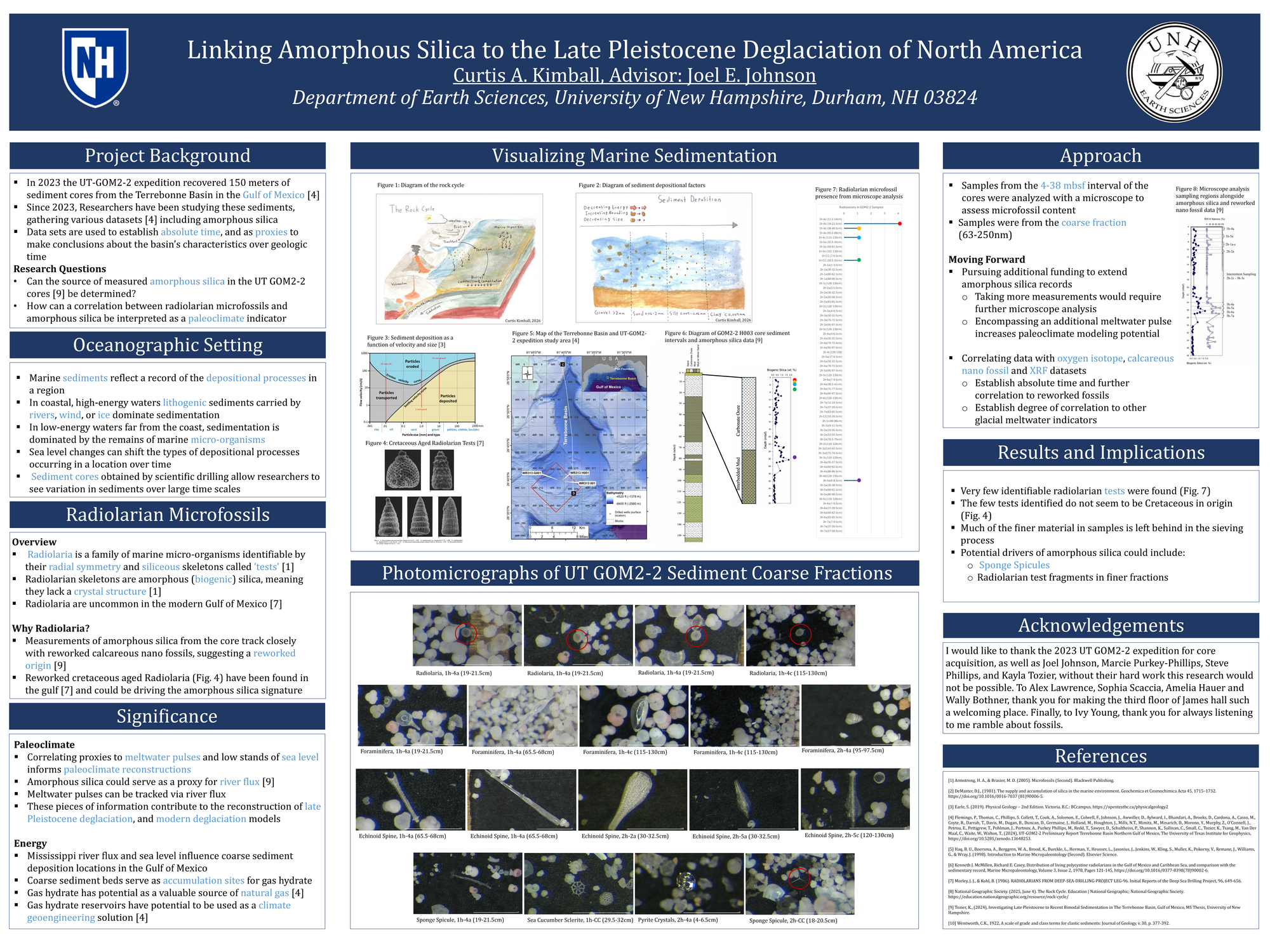
Linking Amorphous Silica to the Pleistocene Deglaciation of North America
Poster
Preview Converted Images may contain errors
Abstract
Sediment deposition is a complex process in which the shape, origin, distribution, and composition of sediments are predictably influenced by environmental factors such as geologic setting, climate regime, transport mechanism, and water chemistry. What makes a sedimentary record useful for the study of Earth’s history and climate is that these sediment characteristics can be preserved through time, allowing ancient sediments to be studied in order to make conclusions about the conditions in which they were originally deposited. Various proxy measurements are used to make these conclusions, including mineral composition, microfossil presence and abundance, and the chemistry of the pore water between grains. This project investigated how the presence of siliceous microfossils in late Pleistocene sedimentary records from the Gulf of Mexico may serve as a proxy for glacial meltwater pulses via Mississippi river flux during the last major deglaciation of North America. The project aimed to show that amorphous silica measurements are a suitable tracker of these fossils and correspond to known meltwater and river flux indicators throughout geologic time. Establishing this link could inform models reconstructing the region’s deglacial history and modeling the past and future impacts of a changing climate on major ice sheets.
Authors
| First Name |
Last Name |
|
Curtis
|
Kimball
|
Leave a comment
Submission Details
Conference URC
Event Interdisciplinary Science and Engineering (ISE)
Department Earth and Environmental Sciences (ISE)
Group Earth and Environmental Sciences
Added April 20, 2026, 12:17 p.m.
Updated April 20, 2026, 12:18 p.m.
See More Department Presentations Here