Title:
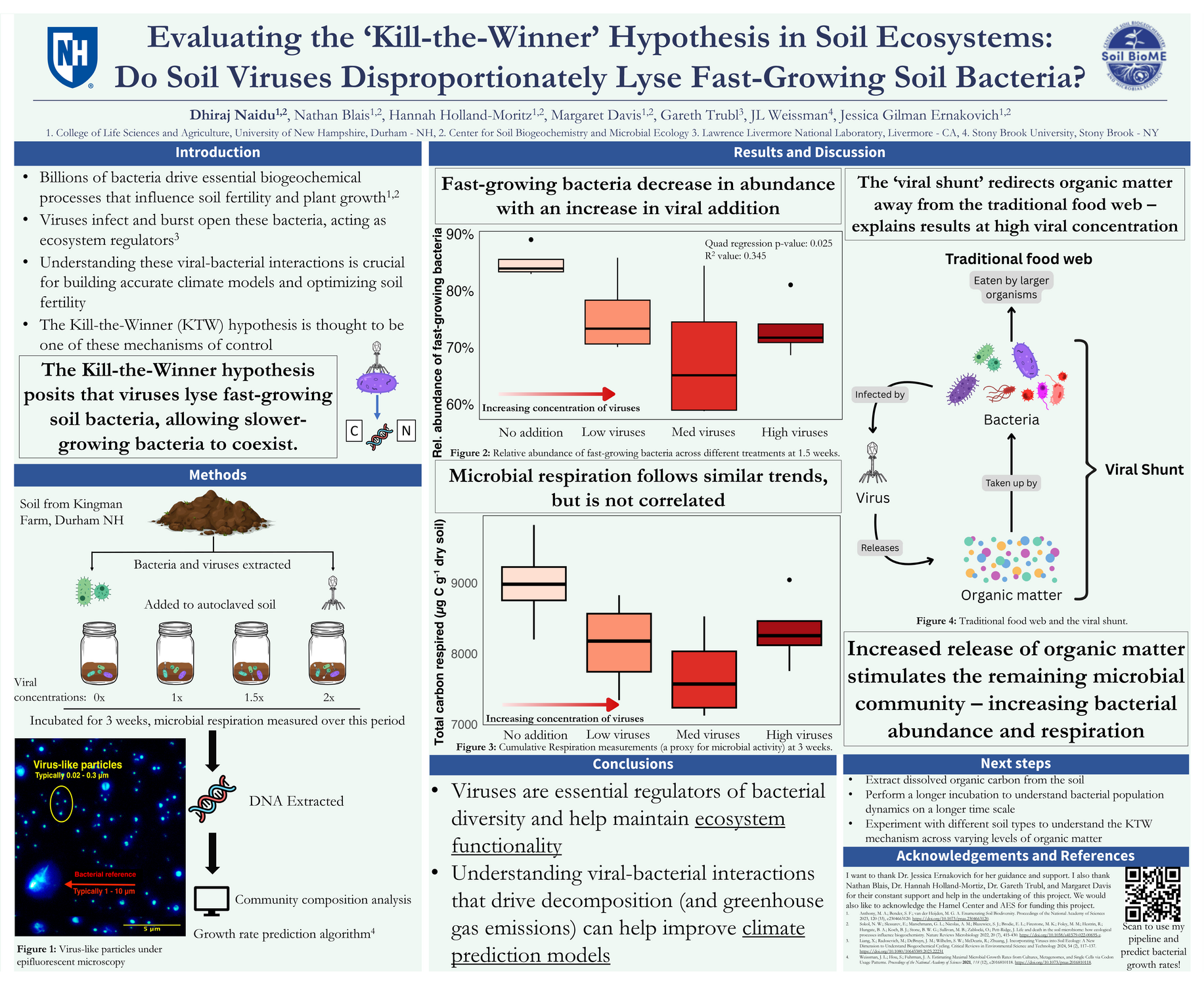
Evaluating the ‘Kill-the-Winner’ Hypothesis in Soil Ecosystems: �Do Soil Viruses Disproportionately Lyse Fast-Growing Soil Bacteria?
Poster
Preview Converted Images may contain errors
Abstract
Soil viruses influence biogeochemical cycling by regulating bacterial populations via cell lysis. The ‘Kill-the-Winner’ (KTW) hypothesis posits that viruses disproportionately lyse fast-growing bacteria, allowing slower growers to coexist. While established in marine systems, this remains poorly understood in soils. Viral lysis releases necromass, altering decomposition, nutrient availability, and carbon sequestration—key factors for agriculture and climate science. To test if soil viruses disproportionately lyse fast-growing microbes, we conducted a 3-week lab incubation. Sterilized soil was inoculated with bacteria and spiked with varying viral concentrations. We measured microbial respiration to assess metabolic activity, used 16S rRNA sequencing to identify bacterial taxa, and estimated maximal growth rates using the R package gRodon. We hypothesized that higher viral loads would suppress fast-growing bacteria and reduce microbial respiration. Results supported this: we observed a significant decline in the relative abundance of fast-growing bacteria with increasing viral loads. Additionally, carbon respiration decreased as viral concentration increased. These findings evidence the KTW dynamic in soils, showing viruses are vital top-down regulators of bacterial communities and carbon cycling.
Authors
| First Name |
Last Name |
|
Nathan
|
Blais
|
|
Dhiraj
|
Naidu
|
Advisors:
| Full Name |
|
Jessica G Ernakovich
|
|
Nathan Blais
|
Leave a comment
Submission Details
Conference URC
Event Interdisciplinary Science and Engineering (ISE)
Department Biology (ISE)
Group Biology
Added April 20, 2026, 10:31 a.m.
Updated April 20, 2026, 10:32 a.m.
See More Department Presentations Here