Title:
Green Colloidal Electrospinning of Degradable Nanofibers
Poster
Preview Converted Images may contain errors
Abstract
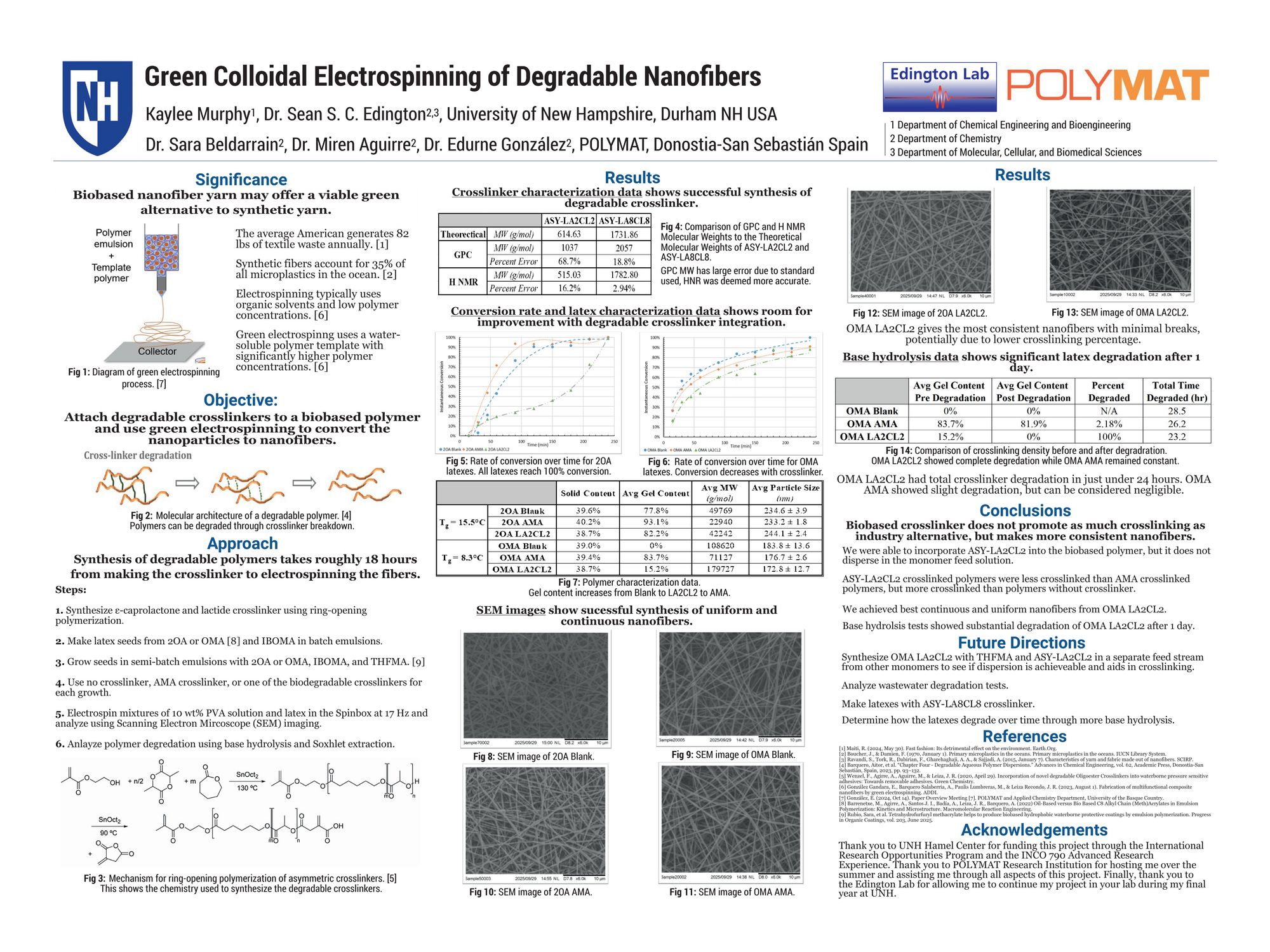
This project combines two previously developed techniques to create a degradable nanofiber with potential applications in various fields such as in tissue engineering, wound dressings, biosensors, drug delivery, filtration, and clothing. Biobased latex nanoparticles are synthesized from 2-octyl acrylate (2OA) or octyl methacrylate (OMA), isobornyl methacrylate (IBOMA), and tetrahydrofurfuryl methacrylate (THFMA) in batch emulsion polymerization. The degradable crosslinkers are made of ε-caprolactone and lactide using ring opening polymerization. The biobased latex seed is grown with degradable crosslinkers in semi-batch emulsion to generate the degradable biobased latex. The crosslinking density of the nanoparticles is measured with Soxhlet extraction. Crosslinking density of nanoparticles with the degradable crosslinkers is compared to the crosslinking density of a standard synthetic crosslinker allyl methacrylate (AMA) and the crosslinking density of a latex without any crosslinker (Blank). The nanoparticles coalesce into uniform continuous nanofibers through green electrospinning. The degradability of the latex particles and nanofibers is analyzed by comparing their original crosslinking density to the crosslinking density of the particles and fibers after base hydrolysis degradation. The nanofiber compositions are examined with a Scanning Electron Microscope (SEM) to ensure successful electrospinning. This project shows successful incorporation of the degradable crosslinker into the biobased polymer backbone. The nanofibers of each latex are uniform and continuous. However, the degradable crosslinkers did not promote crosslinking as well as the standard synthetic option, allyl methacrylate (AMA). Different feed methods for semi-batch emulsion will be employed to attempt to increase the crosslinking density with the degradable crosslinker. Wastewater degradation tests are still underway, and the base hydrolysis tests show complete degradation of the degradable crosslinker. The future goal of this project is the development of a degradable textile that releases no microplastics upon washing and undergoes benign breakdown after disposal.
Authors
| First Name |
Last Name |
|
Kaylee
|
Murphy
|
Leave a comment
Submission Details
Conference URC
Event Interdisciplinary Science and Engineering (ISE)
Department Chemistry (ISE)
Group Chemistry Research
Added April 18, 2026, 12:08 a.m.
Updated April 18, 2026, 12:08 a.m.
See More Department Presentations Here