Title:
Development of the Thermospheric Winds Imager
Poster
Preview Converted Images may contain errors
Abstract
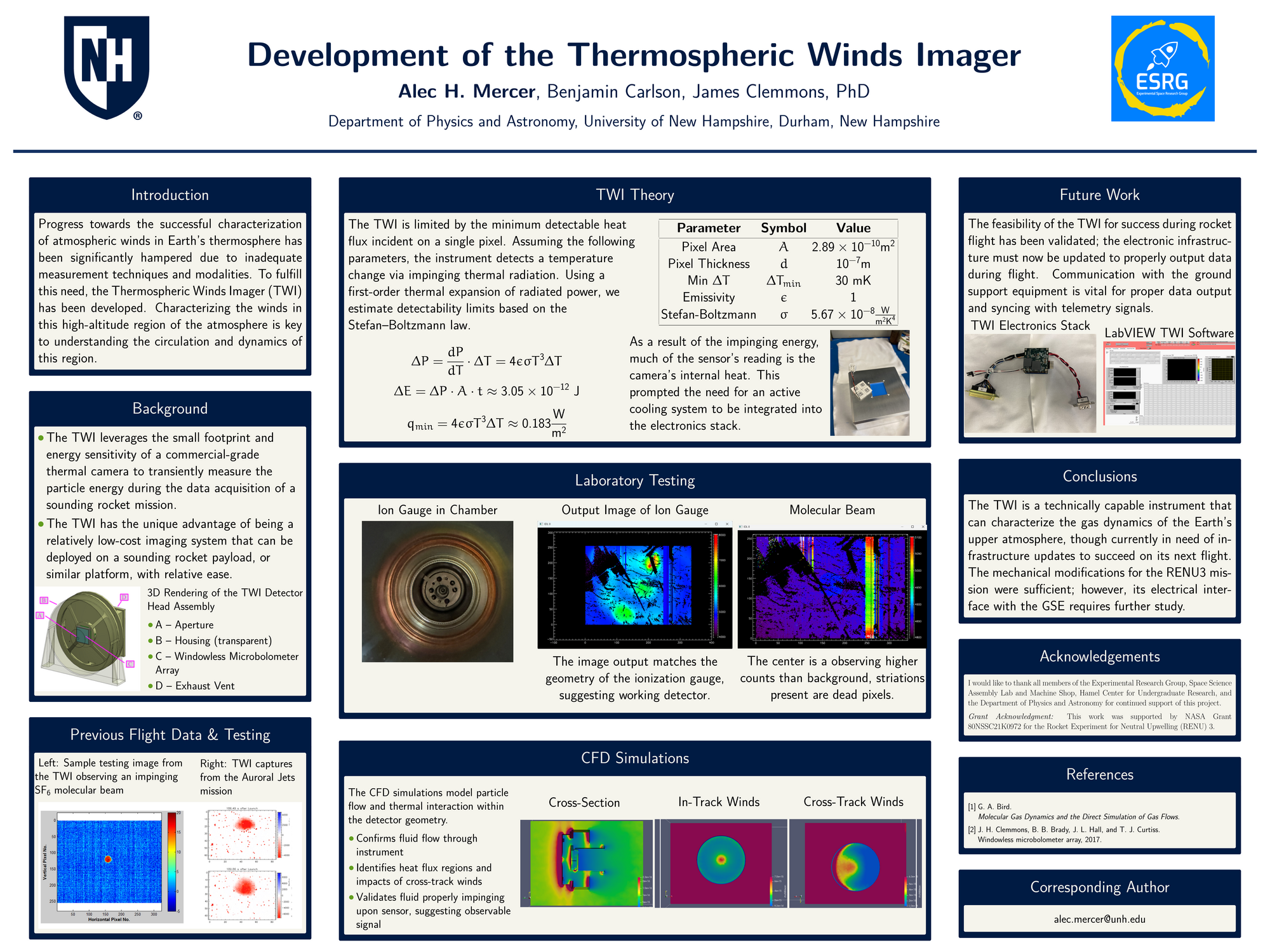
Progress towards the successful characterization of atmospheric winds in Earth’s thermosphere has been significantly hampered due to inadequate measurement techniques and modalities. To fulfill this need, a novel application of thermal imaging technology has been implemented to measure two velocity components of thermospheric winds, and the temperature of ambient gas particles from these winds in situ. The Thermospheric Winds Imager (TWI) leverages the small footprint and energy sensitivity of a commercial-grade thermal camera to transiently measure the particle energy during the data acquisition of a sounding rocket mission. Additionally, the TWI has the unique advantage of being a relatively low-cost imaging system that can be deployed on a sounding rocket payload with relative ease. Despite its capability and cost-effectiveness, it has yielded enigmatic results during prior space-flight missions due to the thermal sensitivity of the camera and improper mitigation of thermal energy. Advancement in TWI hardware has enabled stable, transient image capture during flight with the addition of active cooling, eliminating much of the dark current and fixed-pattern noise emitted from the camera itself. Building upon the updated hardware will lead towards a greater understanding of the rarefied gas dynamics of winds in the Earth’s thermosphere in addition to interactions with the ionosphere and other regions of geospace. The TWI has been deployed on the Rocket Experiment for Neutral Upwelling 3 (RENU3) mission during late November of 2025, failing to yield data due to improper communication with telemetry. The lack of flight data prompts the need to develop a more robust firmware infrastructure and image processing pipeline for the TWI to be able to successfully make measurements on the velocity of neutral gases in situ. This project will improve upon prior work to develop this instrument’s electronic design and ensure efficacy of the TWI in a vacuum setting through experimental laboratory testing.
Authors
| First Name |
Last Name |
|
Alec
|
Mercer
|
Leave a comment
Submission Details
Conference URC
Event Interdisciplinary Science and Engineering (ISE)
Department Physics (ISE)
Group Physics – Engineering
Added April 17, 2026, 2:43 p.m.
Updated April 17, 2026, 2:43 p.m.
See More Department Presentations Here