Title:
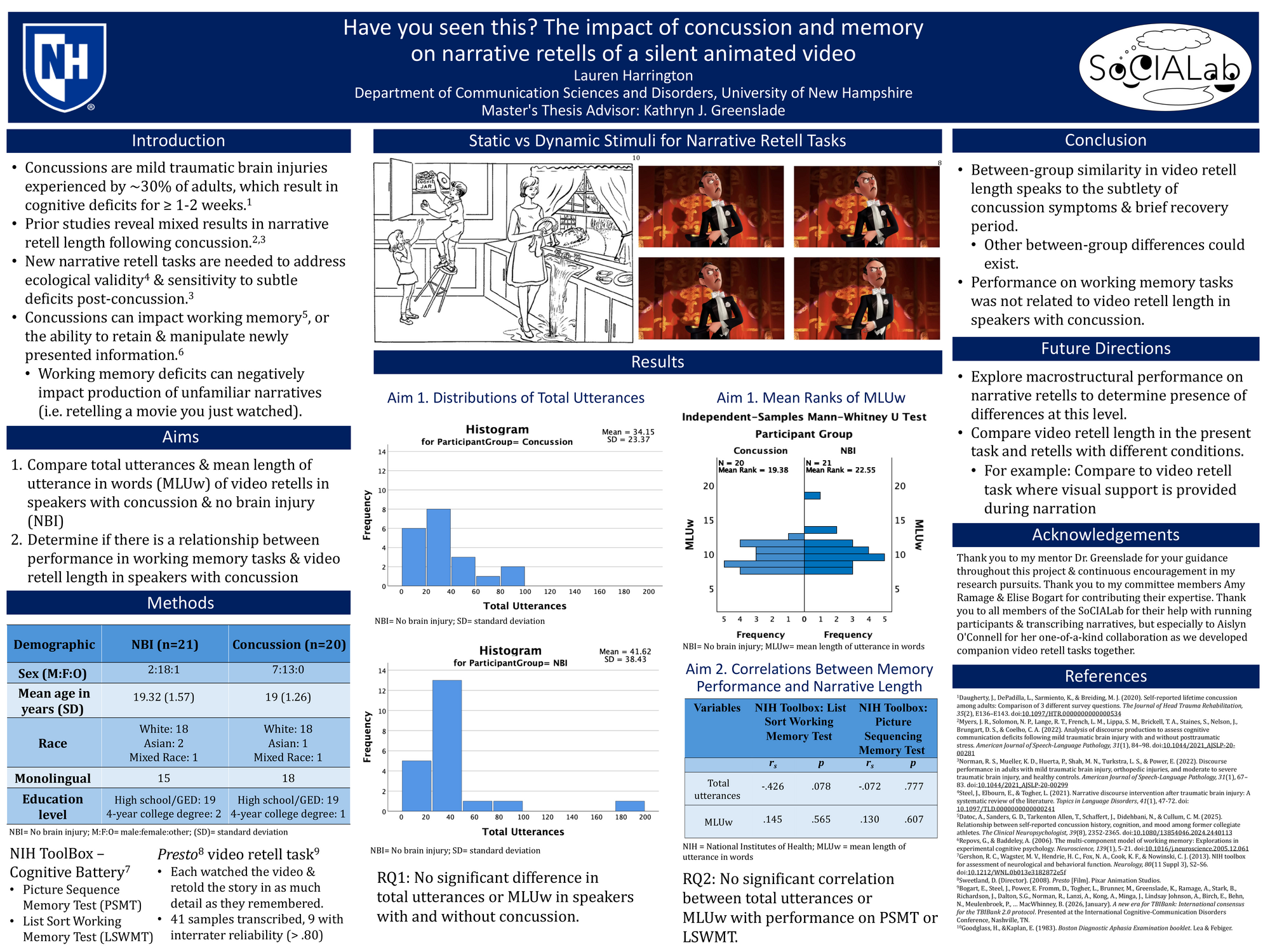
Have you seen this? Impact of concussion & memory on narrative retells of silent animated video
Poster
Preview Converted Images may contain errors
Abstract
Background: Concussions are mild traumatic brain injuries (TBIs), reportedly experienced by 30% of adults at some point in their lives (Daugherty et al., 2021). While spontaneous recovery typically occurs 7-10 days following injury, people often report persistent cognitive impacts, leading to difficulty navigating social interactions with neurologically healthy peers (Datoc et al 2024; Greenberg et al., 2023). Two specific cognitive skills people with concussion exhibit deficits in are working memory- the ability to retain and manipulate newly presented information- and episodic memory- memory of scenes that have occurred, similar to recalling a television episode. Previous studies have revealed mixed results in differences of narrative length between speakers with and without concussion (Myers et al., 2022; Norman et al, 2022); however, more information is needed on the relationship between memory and narrative production in speakers with concussion (Tulsky et al., 2017).
Aims: The present study pilots the retell task of a silent animated video as part of an updated protocol for discourse analysis. Specifically, this study compares the total number of utterances and mean length of utterance in words (MLUw) in video retells by speakers with and without concussion. Given the existing evidence regarding narrative productivity when presented with an unfamiliar story, it was predicted that speakers with concussion would have different length narrative retells than healthy controls. Additionally, the present study aimed to assess the relationship between length of narrative retells and performance on working and episodic memory tasks in speakers with concussion, to determine the contribution of memory in recalling and sharing information from videos. It was predicted that poorer performance on these memory tasks will correlate with shorter (less detailed) stories, reflecting difficulty recalling events and details from the video.
Methods: The present study included 20 participants with concussion and 21 neurologically healthy controls. All participants met the following eligibility criteria: 1) at least 18 years of age; 2) proficiency in English; 3) hearing and vision within functional limits to complete study tasks; 4) no current use of psychoactive medications; 5) no history of developmental disorders, 6) no history of special education services for cognitive or communication needs, and 7) providing written consent to participate and be recorded during on-campus sessions. Additional criteria for participants with concussion included: 1) injury occurred greater than one month prior to study visit and no more than five years prior and 2) current presence of symptoms as determined by responses on the Neurobehavioral Symptom Inventory. Additional criteria for control participants included no history of brain injury or neurological disorder. In-person study visits consisted of a hearing screening, completion of the NIH ToolBox Cognitive battery, and Neurobehavioral Symptom Inventory, as well as a video retell task of the Pixar animated short, Presto. Scores from two tasks in the NIH ToolBox Cognitive battery, the List Sort Working Memory Task and the Picture Sequence Manual, were used as dependent variables of working and episodic memory, respectively. All tasks completed during the in-person study visit were recorded with participants’ written consent. To acquire measures on narrative retell length, retellings of Presto task were transcribed by graduate student research assistants, trained in using the CHAT transcription conventions (MacWhinney, 2000). Interrater reliability for transcription was measured for 20% of transcripts (9 transcripts; concussion n = 5) (total utterance ICC (2,1) = .999; MLUw ICC (2,1) = .904).
Results: Mann Whitney U tests were used to compare measures of narrative length in speakers with and without concussions. Total utterances were not statistically significantly different between healthy contorls (Mdn = 38.00) and the speakers with concussion (Mdn = 26.50) (Mdn = 32.000, z = 2.020, p = .155). For measures of MLUw, speakers with NBI (mean rank = 22.55) and with concussion (mean rank = 19.38) had no statistically significant difference, U = 177.500, z = -.848, p = .397. Spearman's rho revealed no statistically significant relationships between either measure of memory to either measure of narrative length.
Discussion: Results from the present study reflect the mild, short-term symptoms often experienced by speakers with concussion. Analysis of story content, presence of vague or tangential language, and use of mental state terms should be completed to determine between group differences in performance of macrostructural elements of storytelling. Additionally, comparison of narrative length in the present task should be compared to narrative length in video retell tasks in which visual supports are provided during narrative production, to determine if memory aids impact narrative length in healthy controls or speakers with concussion.
Authors
| First Name |
Last Name |
|
Kathryn
|
Greenslade
|
|
Lauren
|
Harrington
|
Leave a comment
Submission Details
Conference GRC
Event Graduate Research Conference
Department Communication Sciences and Disorders (GRC)
Group Teaching Excellence and Scholarship
Added April 14, 2026, 12:48 p.m.
Updated April 14, 2026, 12:49 p.m.
See More Department Presentations Here