Title:
Getting Unstuck: Compounding Factors of Treatment-Related Inflexible Partial-Skill Learning
Poster
Preview Converted Images may contain errors
Abstract
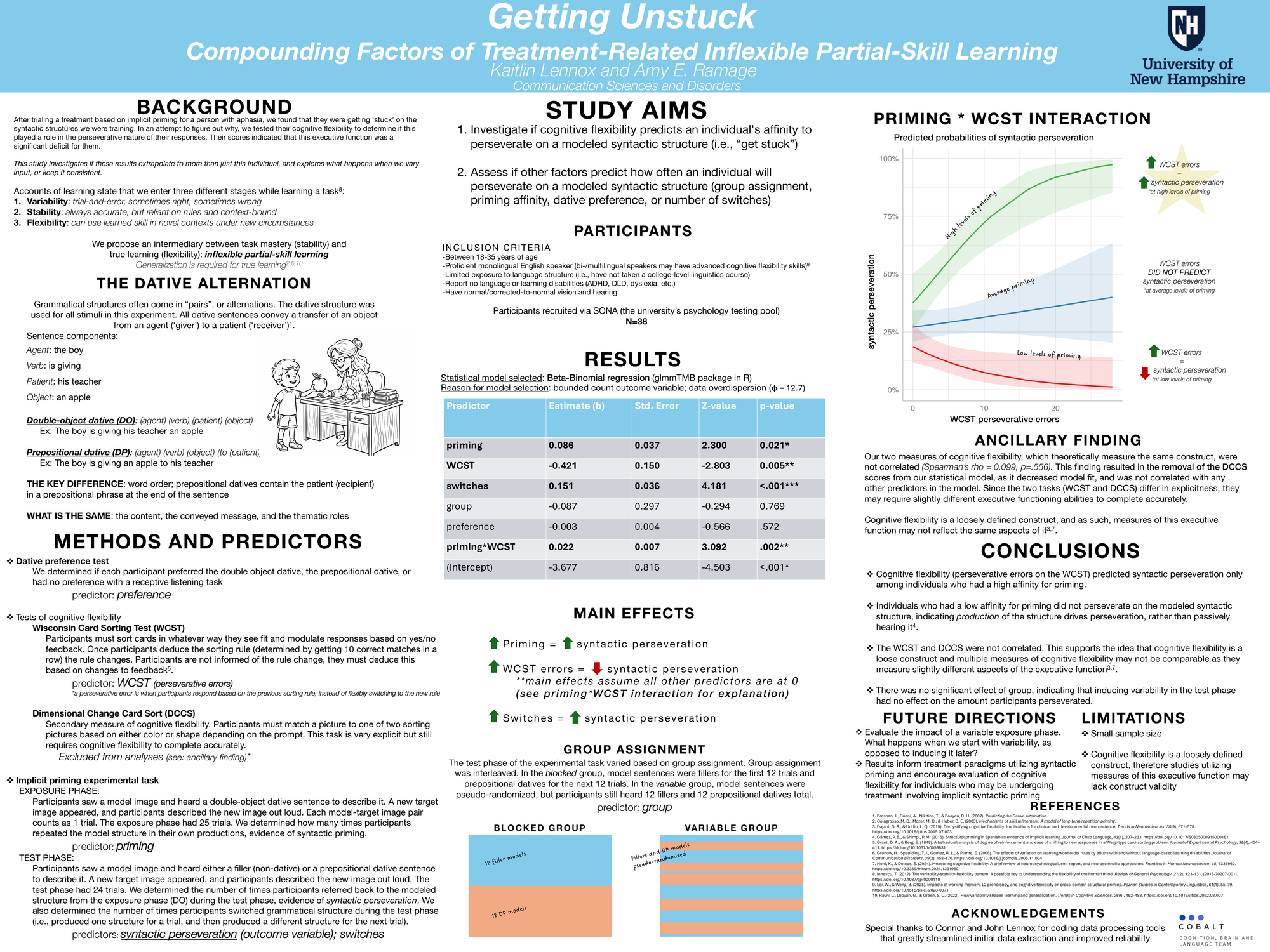
Introduction: Our brains are wired to identify patterns. This ability allowed humans to develop complex systems of language, and it is these same skills that allow infants and children to implicitly acquire the rules and structures that govern our languages. Implicit statistical learning (ISL) is thought to be responsible for the subconscious acquisition of language-related skills. ISL is increasingly being investigated as a treatment mechanism for those with acquired language disorders such as aphasia via syntactic priming. An important caveat to learning is the distinction between task mastery and true skill learning. We propose an intermediary between these two conditions: inflexible partial-skill learning. This describes apparent task mastery in the absence of generalization, a requirement of true learning.
Current study: Participants completed an implicit priming task consisting of an exposure phase and test phase. This study investigates what happens when inflexible partial-skill learning is promoted with an invariable exposure phase consisting of only double-object dative models. Test phases varied by group assignment. Participants were assigned to either a blocked or variable group. Participants in the blocked test phase heard 12 filler trials followed by 12 prepositional dative models. Participants in the variable test phase heard the same 12 filler trials and prepositional dative models, but in a pseudo-randomized order. We investigated if priming (i.e. repetition of modeled structure) during the exposure phase, cognitive flexibility, production variability (i.e. switches), or group assignment predicted syntactic perseveration (i.e. use of the previously modeled structure in the test phase).
Results: Beta-binomial regression revealed significant main effects of priming affinity (p=.021), switches (p<.001), and cognitive flexibility (p=.005). A significant two-way interaction was found between priming and cognitive flexibility (p=.002). At high levels of priming, cognitive flexibility predicted syntactic perseveration.
Conclusions: Consideration of input variability is essential for development of efficacious implicit syntactic priming treatment paradigms. Cognitive flexibility should be evaluated in populations where implicit syntactic priming is utilized as a treatment mechanism.
Authors
| First Name |
Last Name |
|
Amy
|
Ramage
|
|
Kaitlin
|
Lennox
|
Leave a comment
Submission Details
Conference GRC
Event Graduate Research Conference
Department Communication Sciences and Disorders (GRC)
Group Interdisciplinary Research
Added April 13, 2026, 10:15 p.m.
Updated April 13, 2026, 10:16 p.m.
See More Department Presentations Here