Title:
Shellfish Consumption and Blood PFAS Levels: A Cross-Sectional Study
Poster
Preview Converted Images may contain errors
Abstract
Background
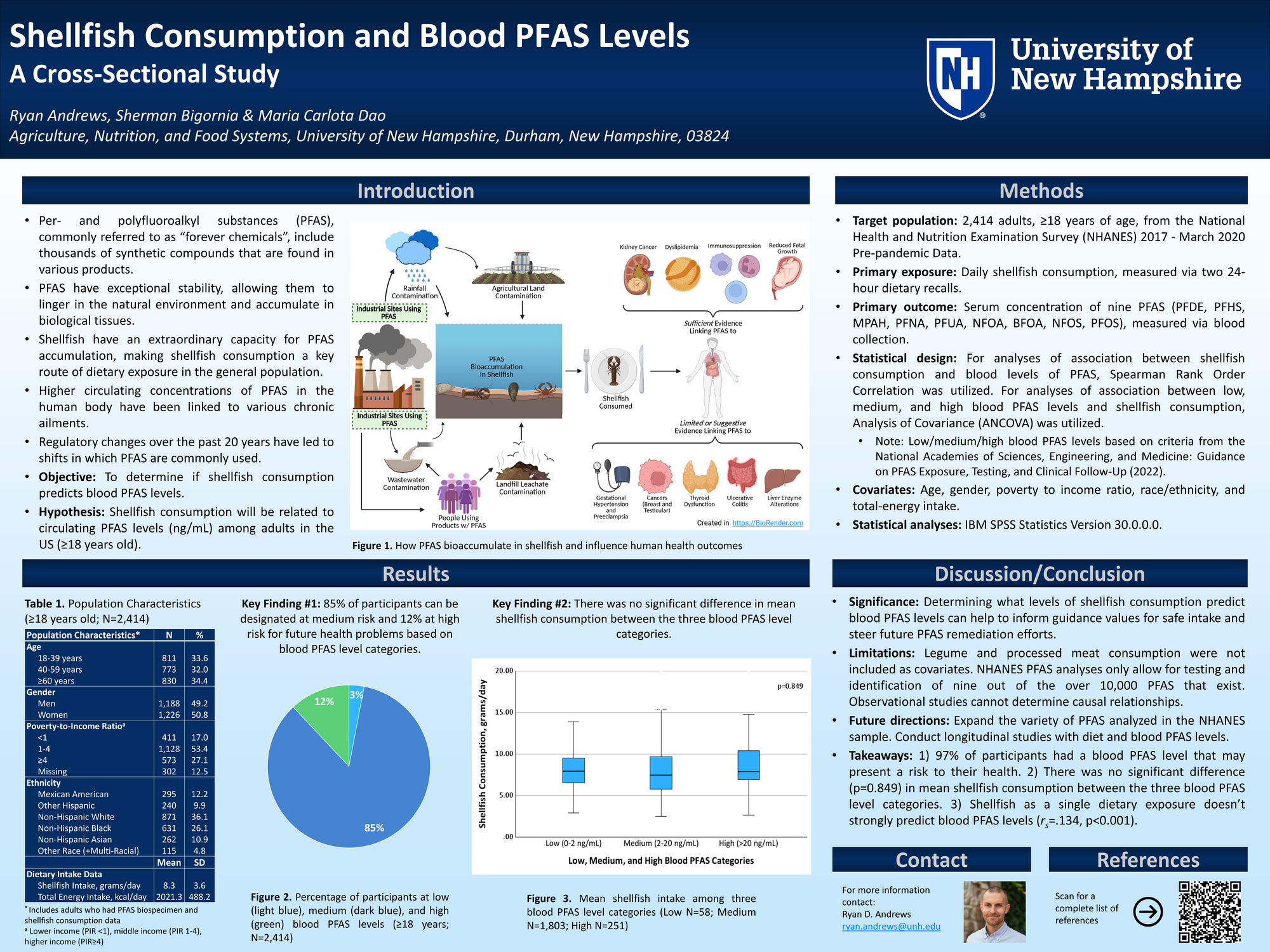
Per- and polyfluoroalkyl substances (PFAS) have been used in a wide array of products for the past several decades. PFAS have an extremely stable chemical structure allowing them to resist oil and water and minimize friction. These qualities also uniquely allow PFAS to linger in the natural environment and accumulate in biological tissues. Higher circulating concentrations of PFAS in the human body have been linked to various chronic ailments, with sufficient evidence of an association for increased risk of kidney cancer, dyslipidemia, reduced infant and fetal growth, and decreased immune function. Shellfish have an exceptional capacity for PFAS accumulation, making shellfish consumption a key route of exposure for the general population. Determining what levels of shellfish consumption predict blood PFAS levels could help to inform guidance values for safe intake and future remediation efforts.
Objective
To determine if shellfish consumption in adults (>/=18 years old) predicts circulating blood PFAS levels (ng/mL).
Methods
This cross-sectional study will utilize data from the 2017 - March 2020 Pre-pandemic National Health and Nutrition Examination Survey (NHANES). The primary exposure is shellfish consumption, measured via two 24-hour dietary recalls. The primary outcome will be serum concentration of nine PFAS (PFDE, PFHS, MPAH, PFNA, PFUA, NFOA, BFOA, NFOS, PFOS), measured via biospecimen collection. The target population will be adults (>/=18 years old). For analyses of association between shellfish consumption and blood levels of PFAS, Spearman Rank Order Correlation was utilized. For analyses of association between low, medium, and high blood PFAS levels and shellfish consumption, Analysis of Covariance (ANCOVA) was utilized. Covariates include age, gender, poverty to income ratio, race/ethnicity, and total-energy intake.
Conclusions
Ninety seven percent of participants had a blood PFAS level that may present a risk to their health. There was no significant difference (p=0.849) in mean shellfish consumption between the three blood PFAS level categories. And shellfish as a single dietary exposure doesn’t strongly predict blood PFAS levels (rs=.134, p<0.001). Avoiding any single dietary exposure to PFAS won’t solve the more significant PFAS pollution problem faced by society. But learning about dietary exposures through NHANES moves communities one step closer to understanding the scale of the problem. Long term, this research could inform legislation around how these chemicals are used and regulated throughout society, helping to steer PFAS remediation efforts.
Authors
| First Name |
Last Name |
|
Maria Carlota
|
Dao
|
|
Sherman
|
Bigornia
|
|
Ryan
|
Andrews
|
Leave a comment
Submission Details
Conference GRC
Event Graduate Research Conference
Department Agriculture, Nutrition, and Food Systems (GRC)
Group Teaching Excellence and Scholarship
Added April 9, 2026, 6:18 p.m.
Updated April 9, 2026, 6:18 p.m.
See More Department Presentations Here