Title:
Linking Laboratory Performance and Mechanistic Modeling to Predict Cracking Resistance of Asphalt Overlays
Poster
Preview Converted Images may contain errors
Abstract
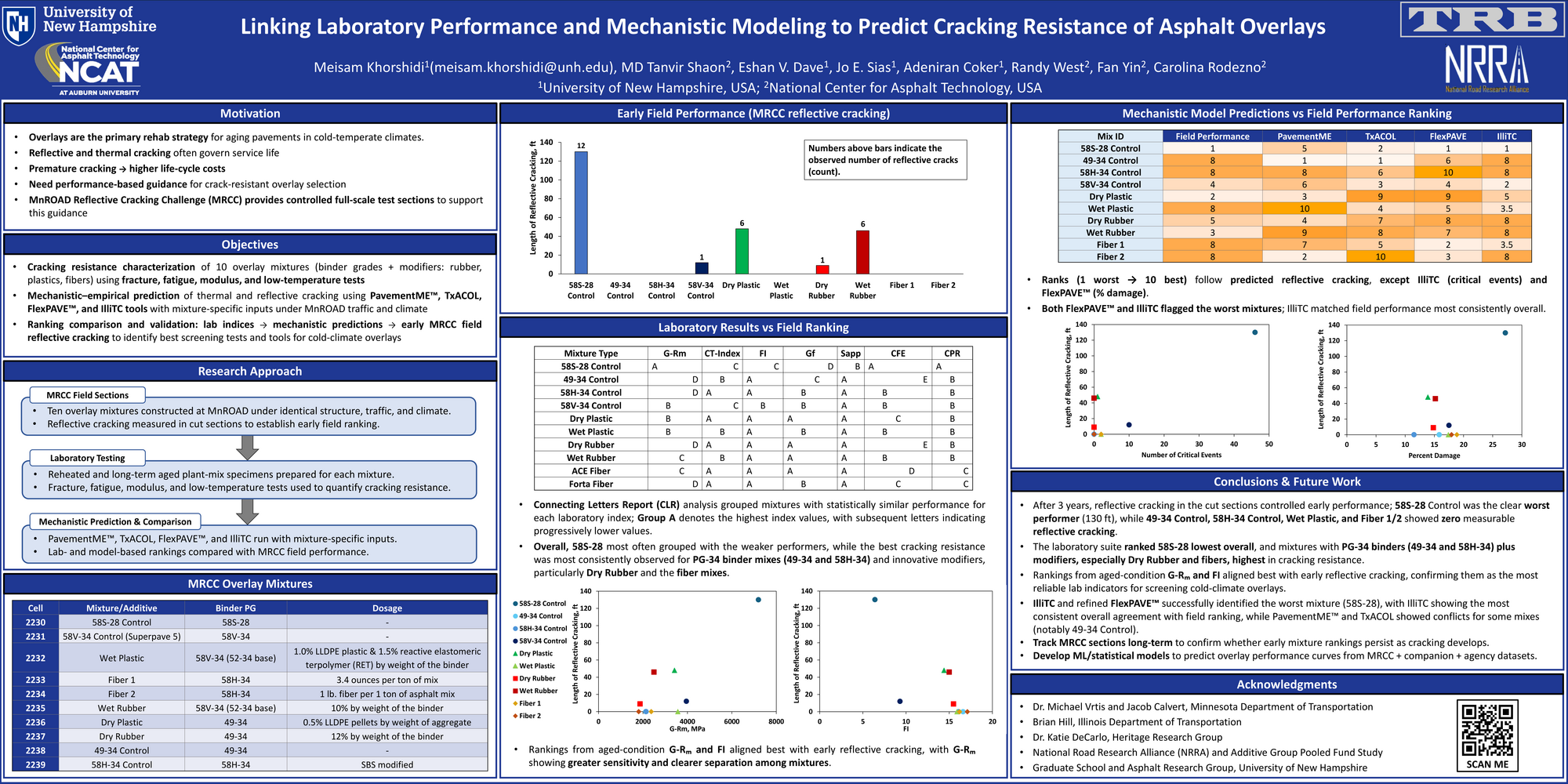
Asphalt overlays are widely used to extend pavement service life, but in cold climates their durability is often limited by premature reflective and thermal cracking. Improving cracking resistance is therefore important not only for pavement performance, but also for sustainability, because longer-lasting overlays can reduce maintenance frequency, material consumption, traffic disruption, and construction-related environmental burdens. This study evaluated the cracking resistance of ten asphalt overlay mixtures constructed under the MnROAD Reflective Cracking Challenge (MRCC), where all sections were subjected to the same pavement structure, traffic, and climate. The mixtures included four control sections and six sections modified with rubber, recycled plastics, or fibers. A laboratory testing program was used to characterize cracking resistance through fracture, fatigue, modulus, and low-temperature performance, while four mechanistic models, PavementME™, TxACOL, FlexPAVE™, and IlliTC, were used to predict field cracking performance. Early field performance was assessed from reflective cracking in the saw-cut sections after three years of service.
Results showed that the 58S-28 control mixture consistently had the weakest cracking resistance in laboratory results, model predictions, and field observations, while mixtures with softer low-temperature binders and selected modifiers performed better. Among the laboratory indicators, aged-condition G-Rm and Flexibility Index (FI) showed the strongest agreement with early field reflective cracking. Among the mechanistic tools, IlliTC showed the most consistent alignment with observed field ranking, while FlexPAVE™ also identified the most crack-susceptible mixtures after refinement with mixture-specific thermal inputs. Overall, the findings show that combining advanced laboratory characterization with mechanistic modeling can improve the screening of crack-resistant overlays. This supports more sustainable pavement rehabilitation by helping agencies select longer-lasting mixtures, including those incorporating recycled and alternative materials, to improve durability and reduce life-cycle resource use.
Authors
| First Name |
Last Name |
|
Carolina
|
Rodezno
|
|
Fan
|
Yin
|
|
Randy
|
West
|
|
Adeniran
|
Coker
|
|
jo
|
Sias
|
|
Eshan
|
Dave
|
|
MD Tanvir
|
Shaon
|
|
Meisam
|
Khorshidi
|
Leave a comment
Submission Details
Conference GRC
Event Graduate Research Conference
Department Civil and Environmental Engineering (GRC)
Group Strengthening UNH's Impact Through Sustainability
Added April 9, 2026, 11:12 a.m.
Updated April 9, 2026, 11:19 a.m.
See More Department Presentations Here