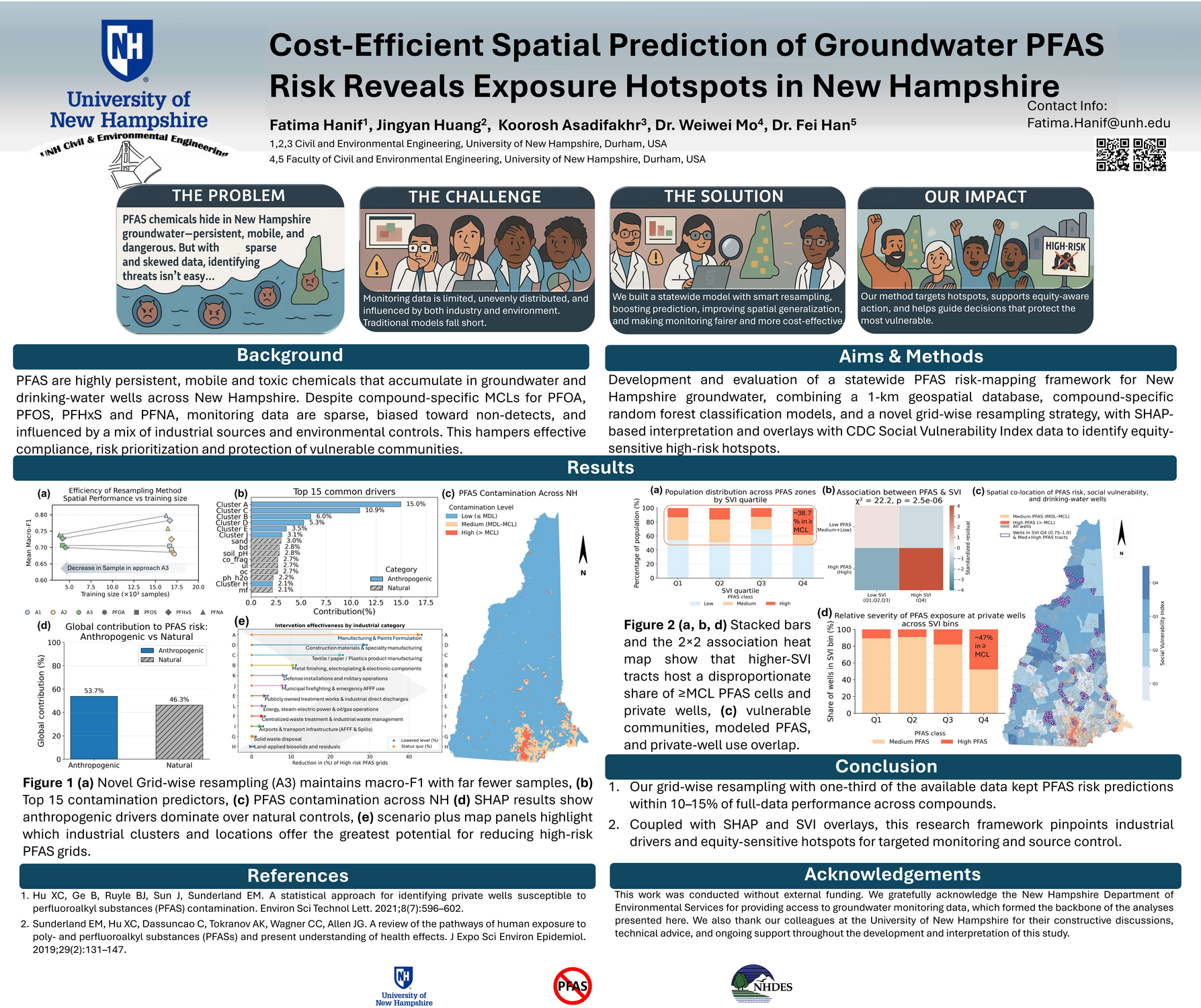
Title:
Cost-Efficient Spatial Prediction of Groundwater PFAS Risk Reveals Exposure Hotspots in New Hampshire
Poster
Preview Converted Images may contain errors
Abstract
Evaluating and predicting groundwater per- and polyfluoroalkyl substances (PFAS) contamination is challenging because monitoring data are often sparse, spatially clustered near suspected sources, and dominated by non-detect measurements, complicating statewide risk assessment. Using New Hampshire (USA) as a testbed, we developed a compound-specific spatial modeling framework to capture PFAS risk for four regulated compounds (PFOA, PFOS, PFHxS, and PFNA) and examine how monitoring design influences statewide inference. Random forest models trained on geospatial indicators of potential sources, land cover, soil and hydrogeologic properties achieved macro-average F1 scores of 0.70–0.78 and revealed consistent spatial risk patterns, with elevated PFAS risk concentrated in southern New Hampshire. Comparisons of alternative sampling strategies show that a spatially-balanced, variability-aware monitoring design can achieve comparable, if not better, predictive performance using only one-third as many samples as denser but spatially clustered sampling designs, indicating substantial opportunities to reduce monitoring costs. Scenario analyses further reveal that industries with moderate predictive importance may still offer substantial leverage for PFAS risk reduction because of their widespread spatial footprint. Notably, the most vulnerable exposure hotspots, where households rely on contaminated private wells, occur outside the major contamination corridors.
Authors
| First Name |
Last Name |
|
Fei
|
Han
|
|
Weiwei
|
Mo
|
|
Koorosh (Kai)
|
Asadifakhr
|
|
Jingyan
|
Huang
|
|
FATIMA
|
HANIF
|
Leave a comment
Submission Details
Conference GRC
Event Graduate Research Conference
Department Civil and Environmental Engineering (GRC)
Group Strengthening UNH's Impact Through Sustainability
Added April 9, 2026, 9:48 a.m.
Updated April 9, 2026, 9:49 a.m.
See More Department Presentations Here