Title:
Step-by-step or all-at-once: Preference for insight problem solving across goals and age groups
Poster
Preview Converted Images may contain errors
Abstract
In a world of endless possibilities, we are constantly faced with decisions about what activities we want to pursue. In the present work, we investigate how these decisions are informed by the cognitive experience people expect to have during an activity. Specifically, we explore whether 4- to 8-year-olds and adults prefer to pursue insight experiences—also known as “Aha!” moments—during problem solving.
Prior work (Mercier et al., 2025) shows that adults report higher interest in seeing more problems after solving problems requiring insight compared to non-insight (“incremental”) problems. However, this preference for insight could be confounded by other correlates of direct insight experience, such as positive affect. Thus, three questions remain open. First, do adults prefer insight even when reducing confounds? Second, what are the developmental roots of the insight preference—does preferring insight require sophisticated mental state reasoning, or does it emerge early in development? Third, do children and adults prefer insight across contexts, or does the preference for insight depend on one’s goals (e.g., having fun versus succeeding quickly)?
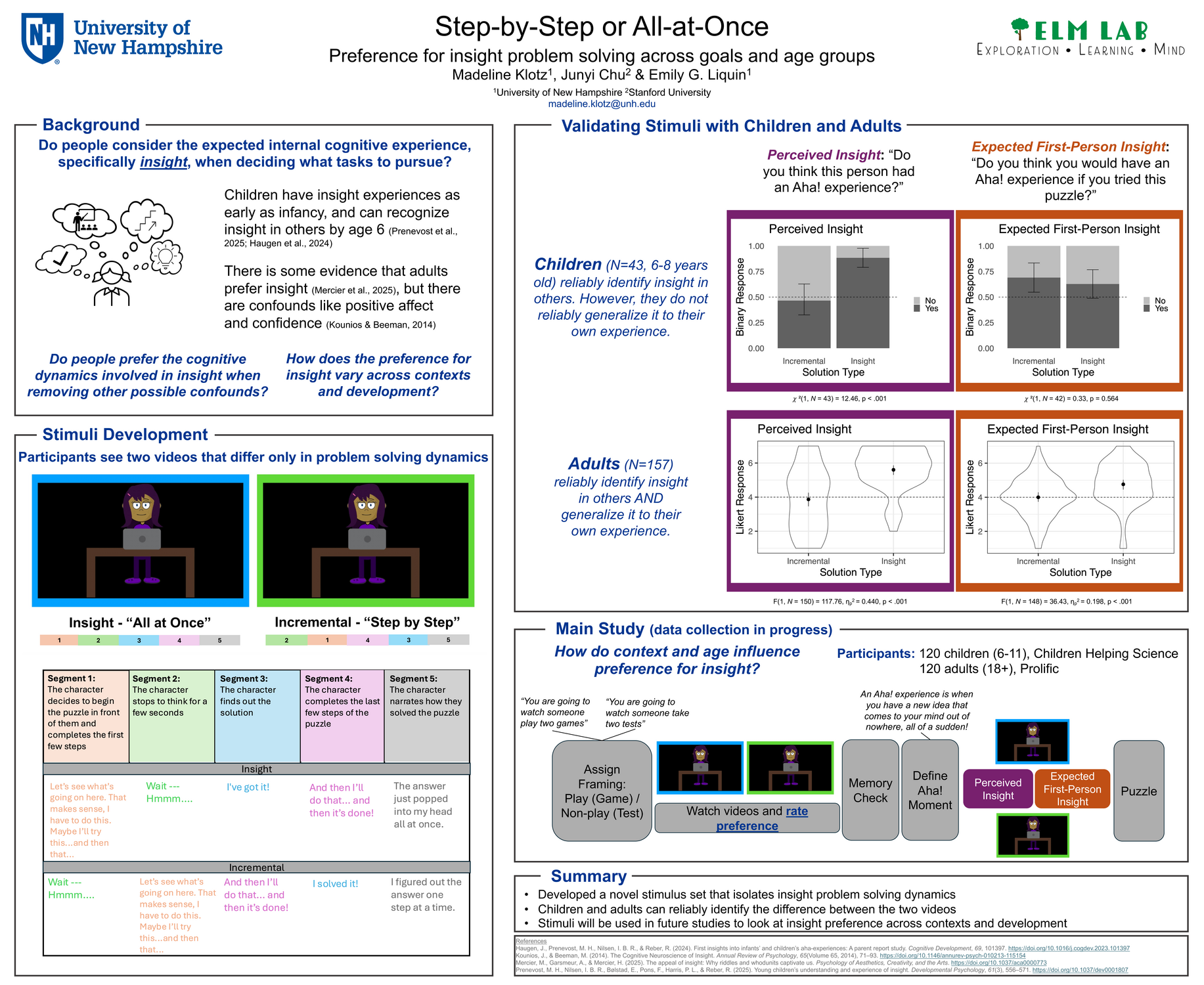
To manipulate participants' expectations of insight, we created two videos showing a character solving a concealed puzzle while thinking aloud. In the insight video, the character initially struggles before suddenly figuring out the solution. The incremental video comprised the same clips but rearranged to show a step-by-step progression. Thus, both videos were matched for overall duration, affect, and success, but conveyed different cognitive experiences.
In Study 1, adults on Prolific (n=157) watched both videos and judged whether the character had an insight experience (1=Definitely No; 7=Definitely Yes). There was a significant effect of video type (p < .001), with higher insight ratings for the insight video (M = 5.89, SD = 1.21) than the incremental video (M = 3.76, SD = 1.93). Participants also thought they were more likely to experience insight when trying the puzzle shown in the insight video (M = 4.80, SD = 1.26) versus the incremental video (M = 4.05, SD = 1.31; p < .001). This suggests that people not only “see” insight in others’ experiences, but they generalize it to their own experience.
In our planned Study 2, we will ask how participant age (4- to 8-year-olds, adults) and goals (have fun, solve quickly) impact participants’ preference for trying the puzzle shown in the insight versus incremental video. Initial pilot data (n=12, 4- to 8-year-olds) suggest that children notice the difference between the two puzzles, with 92% of children responding correctly to a memory check question. We will begin data collection soon and expect to have a full sample (120 children, 120 adults) by April 2026. Taken together, this work will shed light on how children and adults choose where to allocate their efforts, depending on their goals and the cognitive dynamics they expect to experience.
Authors
| First Name |
Last Name |
|
Emily
|
Liquin
|
|
Junyi
|
Chu
|
|
Madeline
|
Klotz
|
Leave a comment
Submission Details
Conference GRC
Event Graduate Research Conference
Department Psychology (GRC)
Group Teaching Excellence and Scholarship
Added April 8, 2026, 9:58 p.m.
Updated April 8, 2026, 9:58 p.m.
See More Department Presentations Here