Title:
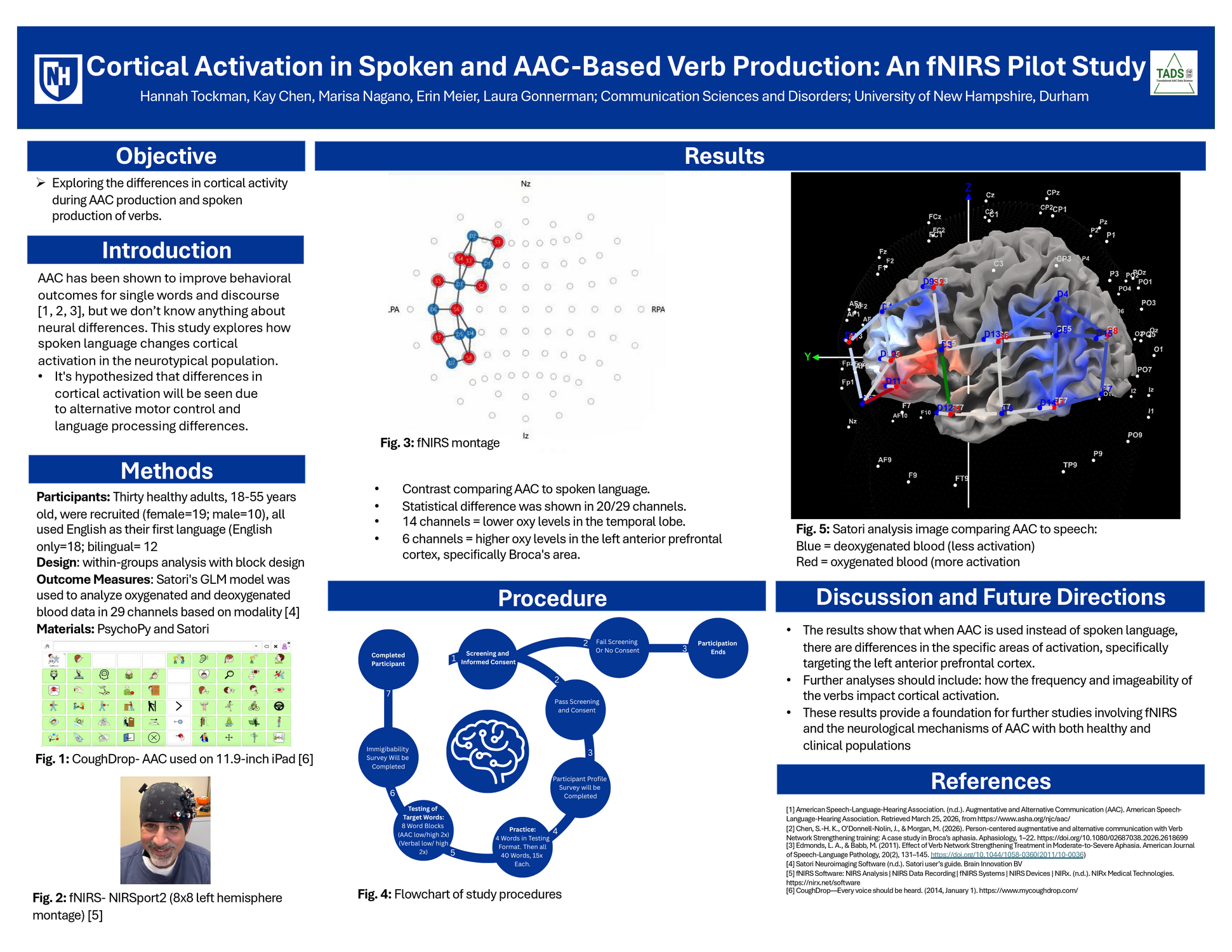
Cortical Activation in Spoken and AAC-Based Verb Production: An fNIRS Pilot Study
Poster
Preview Converted Images may contain errors
Abstract
Background
Augmentative and alternative communication (AAC) is used as a supplement or replacement for verbal speech when there is a communication impairment (American Speech-Language-Hearing Association, n.d.). AAC-based intervention has been shown to have improved behavioral outcomes for both single-word and discourse production (Chen et al. 2026a; Chen et al., 2026b; Dietz et al., 2018). However, how the brain differs in cortical activation when producing words verbally vs. with AAC is largely unknown. Thus, the overall aim of this study is to explore differences in cortical activation in healthy adult participants when producing words using an AAC device vs. speech, with a secondary aim of investigating the effects of target word frequency, as part of a long-term goal to lay a foundation for future studies with clinical populations. It is hypothesized that due to the need for alternative motor control and potential language processing differences, there will be a difference in cortical activation throughout the left hemisphere between AAC production and spoken production, with a secondary prediction that less frequent words will result in higher levels of cortical activation than more frequent words, due to unfamiliarity with the words creating more effortful recall.
Methods - Participants and Materials
Healthy participants (N = 31) were recruited to produce 40 target verbs both verbally and via an AAC system consisting of CoughDrop software installed on a touchscreen tablet (CoughDrop, 2014). For this study, a touch-based Quick Core 60 board including a home display of a 6x10 grid was used. Twenty of the target stimuli verbs were low frequency (e.g., quaff, hearken) and twenty high frequency (e.g., fall, show), as determined by the Corpus of Contemporary American (COCA) English data (COCA, n.d.). Verbs were chosen over other parts of speech since the success of communicating a meaningful message (either verbally or via AAC) relies heavily on verb retrieval and production, as verbs act as the backbone of a coherent sentence (Edmonds & Babb, 2011). NIRx Sport2 (8 by 8) fNIRS system was used to collect fNIRS data in conjunction with Satori software, which was used to analyze the data (Satori Neuroimaging Software, n.d.).
Methods - Procedure
Participants completed one 2-hour session, including a training session, the main experimental task, and a follow-up questionnaire. The training session was designed to familiarize participants with the AAC device by practicing the 40 target words 15 times each. In each training trial, participants saw a target word, and then said the word aloud before locating and pressing the icon for the word on the device. Following this was the main task, in which participants wore an fNIRS device while they produced the 40 target stimuli in 16 blocks of 10 words each; each block consisted of either spoken or AAC production combined with either high- or low-frequency verbs (4 blocks of AAC-produced high-frequency verbs, 4 blocks of AAC-produced low-frequency verbs, 4 blocks of spoken high-frequency verbs and 4 blocks of spoken low-frequency verbs).
Data Analysis
fNIRS data preprocessing consisted of motion correction and channel regression to eliminate noisy channels (Satori Neuroimaging Software, n.d.; Zimeo et al., 2018). After the data was preprocessed, Satori’s standard procedure, General Linear Model (GLM), was used to predict Oxy levels (oxygen level in blood measured from scalp) across 29 channels with modality and frequency as predictors (AAC= a, spoken= s, high frequency= h, and low frequency= l).
Results
Preliminary data analysis shows differences in cortical activation between AAC and spoken modalities in Oxy, with the contrast equation al+ah>sl+sh showing statistical differences in 20/29 channels. Of these 20 channels, 14 showed lower Oxy levels in the AAC condition vs. spoken condition; these channels reflect cortical activation in the left temporal gyrus. The remaining 6 channels showed higher Oxy levels in the AAC vs. spoken conditions, and were consistent with left frontal areas, including anterior prefrontal cortex and Broca’s area.
Conclusion
These results show that when AAC is used instead of verbal speech, there are statistically significant differences in cortical activation; specifically, AAC use is associated with higher activation in the left frontal lobe and Broca's area and lower activation in the left temporal lobe compared to speech. This preliminary result provides a foundation to use fNIRS to investigate neurological mechanisms of AAC use in both healthy and clinical populations.
Continued Analysis
Analyses are currently being run examining the effects of verb frequency on cortical activation in different contrasts, including al>ah, sl > sh, al>sl, and ah> sh. Additionally, the influence of imageability of the stimulus verbs, as measured by the questionnaire, will be examined. These additional results will be presented at the 2026 ASHA convention.
Authors
| First Name |
Last Name |
|
Laura
|
Gonnerman
|
|
Erin
|
Meier
|
|
Marisa
|
Nagano
|
|
Kay
|
Chen
|
|
Hannah
|
Tockman
|
Leave a comment
Submission Details
Conference GRC
Event Graduate Research Conference
Department Communication Sciences and Disorders (GRC)
Group Teaching Excellence and Scholarship
Added April 8, 2026, 9:03 p.m.
Updated April 8, 2026, 9:03 p.m.
See More Department Presentations Here