Title:
Associations Between Social and Structural Determinants and Dietary Outcomes Among Perinatal Women Living In New Hampshire
Poster
Preview Converted Images may contain errors
Abstract
Background
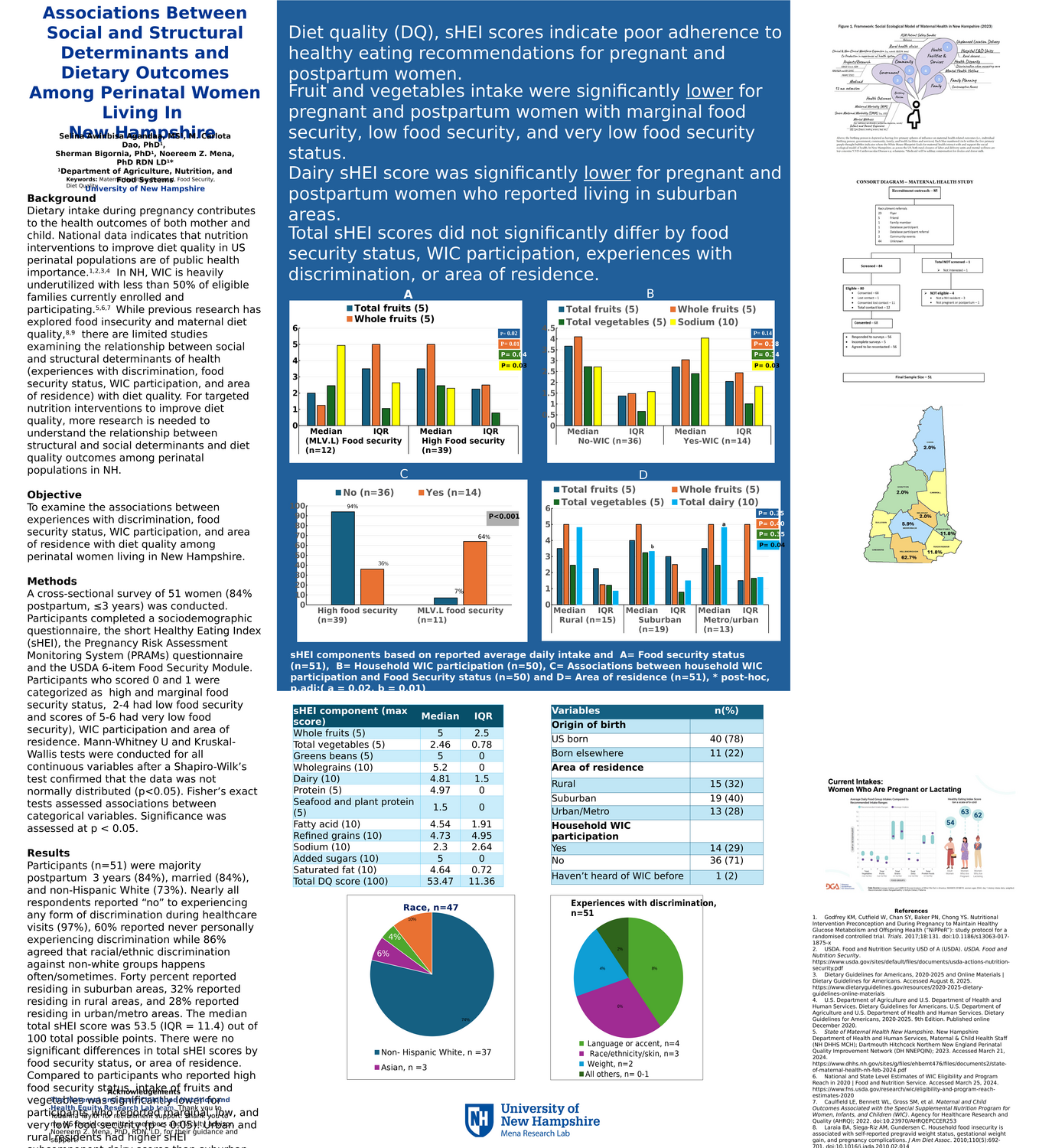
Dietary intake during the perinatal period may influence health outcomes of both mother and child. While previous research has explored food insecurity and maternal diet quality, there are limited studies examining the relationship between social and structural determinants of health (experiences with discrimination, food security status, WIC participation, and area of residence) with diet quality in perinatal populations.
Objective
To examine the associations between experiences with discrimination, food security status, WIC participation, and area of residence with diet quality among perinatal women living in New Hampshire.
Methods
Participants completed a sociodemographic questionnaire, the short Healthy Eating Index (sHEI), the Pregnancy Risk Assessment Monitoring System (PRAMS) questionnaire and the USDA 6-item Food Security Module. Mann-Whitney U and Kruskal-Wallis tests were conducted for all continuous variables after a Shapiro-Wilk’s test confirmed that the data was not normally distributed (p<0.05). Fisher’s exact tests assessed associations between categorical variables. Significance was assessed at p < 0.05.
Results
Participants (n=51) were majority postpartum 3 years (84%), married (84%), and non-Hispanic White (73%). Nearly all respondents reported “no” to experiencing any form of discrimination during healthcare visits (97%), 60% reported never personally experiencing discrimination while 86% agreed that racial/ethnic discrimination against non-white groups happens often/sometimes. Forty percent reported residing in suburban areas, 32% reported residing in rural areas, and 28% reported residing in urban/metro areas. The median total sHEI score was 53.5 (IQR = 11.4) out of 100 total possible points. There were no significant differences in total sHEI scores by food security status, or area of residence. Compared to participants who reported high food security status, intake of fruits and vegetables was significantly lower for participants who reported marginal, low, and very low food security (p < 0.05). Urban and rural residents had higher sHEI subcomponent dairy scores than suburban residents (p.adj = 0.02).
Conclusion
Diet quality in this perinatal population was suboptimal. Food security status and area residence may negatively influence intake of certain critical food groups. Trends in subgroup differences may suggest potential disparities.
Keywords: Maternal Nutrition, Perinatal, Food Security, Diet Quality
Authors
| First Name |
Last Name |
|
Noereem
|
Mena
|
|
Carlota
|
Dao
|
|
Sherman
|
Bigornia
|
|
Selina Awinbisa
|
Agandaa
|
Leave a comment
Submission Details
Conference GRC
Event Graduate Research Conference
Department Agriculture, Nutrition and Food systems/ Nutritional Sciences (GRC)
Group Comimitment to Well-Being & Belonging
Added April 8, 2026, 8:31 p.m.
Updated April 14, 2026, 12:32 p.m.
See More Department Presentations Here